AI Is Changing Relationships Through Companionship, Deception and Trust
AI can help people communicate and find companionship, while raising new concerns about privacy, fake identities and intimate image abuse.
AI is becoming part of how people form and manage relationships, from drafting a first message to seeking emotional support after a fight. That can make communication easier, but it also puts new pressure on privacy and trust: people may be confiding in chatbots, presenting AI-polished versions of themselves, or trying to judge whether someone else’s online identity is real.
Malwarebytes’ March 2026 survey of 1,500 people in the United States, United Kingdom, Germany, Austria and Switzerland captures both sides. Respondents described using AI to navigate difficult conversations and create dating profiles, alongside fears that chatbots might expose private exchanges or that generated images could be used to harass them. The technology is already shaping relationships, even when it doesn’t replace human contact.
Chatbots are entering emotional territory
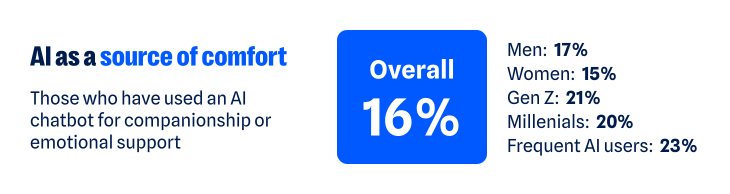
About one in six respondents had used a chatbot for companionship or emotional support. That share rose to about one in five among Gen Z and Millennials, and nearly one in four among people who use AI daily or several times a week. Frequent use appears to make it more likely that people will treat a chatbot as a friend, confidant, adviser or romantic partner.
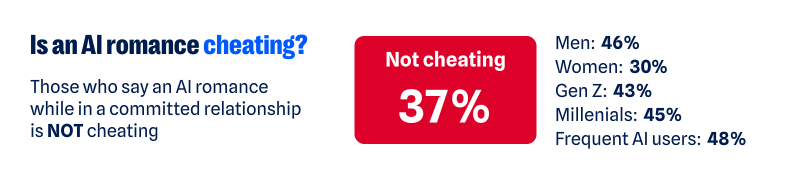
People also disagree about what a chatbot relationship means for an existing partnership. More than one in three respondents (37%) said a romantic relationship with an AI chatbot while already committed to someone else isn’t the same as cheating. Agreement was higher among men than women (46% versus 30%), among Gen Z and Millennials (43% and 45%), and among regular AI users (48%).
These answers point to a practical question for couples: what boundaries apply when one person turns to a chatbot for intimacy, advice or romance? There’s no shared answer in the survey, and the numbers don’t show how couples negotiate the issue. They do show that AI is complicating ideas about fidelity for a substantial part of the population.
Privacy is another concern. Nearly two-thirds (65%) worried that private conversations with AI could be exposed. One respondent said they had used a chatbot for emotional support and found the possibility of those exchanges leaking worrying. The concern is familiar to anyone sharing personal information with a service: an interaction can feel private and personal, but the relationship is with a technology provider, not a human confidant.
Generated images make intimate abuse easier
Generative AI lowers the effort needed to create sexual material featuring someone who never posed for it. A publicly available photo or a person’s likeness can be altered into explicit imagery without their knowledge or consent. The result may be fabricated, but the impact can include coercion, distress and damage to someone’s reputation or finances.
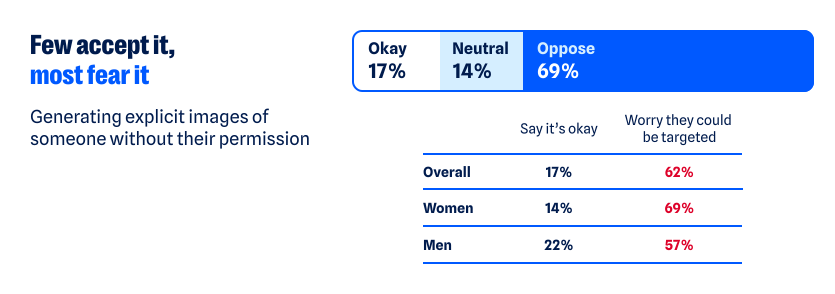
Most respondents opposed generating explicit images of someone without permission, but acceptance was not rare. About one in six said it was acceptable for personal use, while 14% were neutral. Together, nearly one in three (31%) did not explicitly reject the behavior. Views varied by age: 24% of Gen Z and 23% of Millennials said it was acceptable, compared with 13% of Gen X and 5% of Boomers and older respondents. Men were more accepting than women (22% versus 14%).
Concern about becoming a target was much more widespread. Nearly two-thirds (62%) worried someone could make fake nude or sexually explicit images or videos of them. Women reported greater concern than men, at 69% compared with 57%. One in ten respondents said AI had already been used to generate explicit imagery of them without permission; another one in ten said someone had threatened to release such material.
One respondent described someone making fake nude images from their social media photos and threatening to post them on Facebook. That experience changed how cautious they felt about AI. The incident illustrates why consent and the consequences of distribution matter as much as whether an image is authentic.
Polished profiles blur into false identities
People have always chosen flattering photos and edited messages before sending them. AI expands those habits: it can revise a profile, write a reply or generate content that looks and sounds like the person presenting it. More than half of respondents (54%) said AI helps them show their best selves. Nearly half (47%) said using it for that purpose with employers, friends or romantic partners doesn’t amount to presenting a false identity. That view was shared by 58% of Gen Z and Millennials and 64% of regular AI users.
The distinction between editing and deception depends on what the tool changes and what the other person believes they’re seeing. A sharper profile description is different from fabricated photos or a backstory that never happened, but the boundary can be difficult to judge from a screen. One respondent said they left dating apps after discovering that a person’s profile included fake pictures and false information.
People are less comfortable with others controlling that same capability. Two-thirds (67%) worried an online friend or romantic interest might use AI-generated images, video or other content to deceive them. Catfishing and misleading dating profiles existed before generative AI; the technology can make it easier to fabricate a person’s images, messages, voice or history.
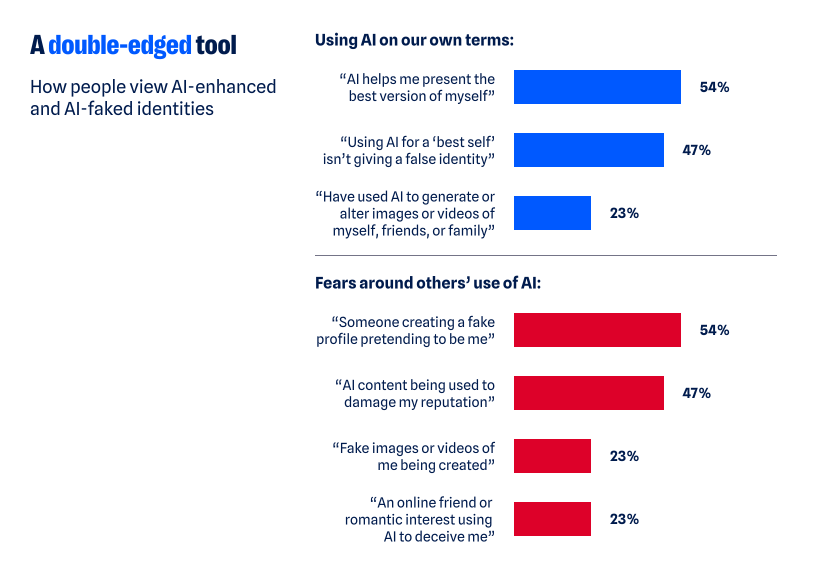
AI can also create a false version of someone without their involvement. Seventy-six percent worried about fake profiles impersonating them, 70% about fabricated images or videos, and 71% about generated content being used to harm their reputation. Relationships depend on people having a reasonable basis to trust who they’re speaking with; synthetic media makes that harder for both sides.
AI can help with difficult conversations
Not every use is deceptive or harmful. More than one in three respondents had used AI to write or edit a message, and about one in seven had sought advice about a relationship or personal decision. One in ten said AI had already changed how they date or communicate romantically; among Gen Z, the figure was nearly one in five.
Some respondents use a chatbot as a way to pause before replying or to consider a partner’s point of view. One said they and their partner used AI as a reflection tool to see situations from each other’s perspective. Another described getting advice about jealousy and becoming less territorial. Others said it helped them stay calm during conflict, find words for a partner or think of ways to make them smile.
AI also helps people shape their introductions. More than one in three said it was acceptable to use AI to create or improve a dating profile, and nearly two-thirds weren’t opposed. One respondent called it a creative adviser for polishing a profile and generating conversation starters. The benefit is clear: a tool can help someone express an idea they already have. The harder question is whether the result still represents them accurately.
Trust is the measure to watch
Nearly nine in ten respondents (88%) said AI makes it harder to tell whether online content is genuinely human or real. Eighty-four percent said even convincing video no longer necessarily feels like proof. Those doubts extend beyond dating: they affect whether people can trust a message, a profile or an image shared by someone close to them.
The survey describes attitudes and self-reported experiences, rather than measuring how often these harms occur across all relationships. Still, its findings show that the same technology can support a conversation and undermine confidence in who is having it. AI may help people find words or feel less alone, but its practical value depends on clear expectations about privacy, disclosure and consent.
The research was based on a March 2026 survey about AI, identity and digital trust. It included 1,500 respondents in the United States, United Kingdom, Germany, Austria and Switzerland, and was prepared by an independent research consultant and distributed via Forsta.