Peter Paul Rubens’ Mythological Paintings Turn Classical Stories Into Moving Scenes
Across 35 years, Rubens shaped myths and religious stories through motion, expressive detail and carefully placed clues.
Rubens’ narrative paintings make familiar stories feel as if they’re unfolding in front of the viewer. Figures twist, fall, reach and recoil; objects left behind point to what has just happened, while gestures and expressions hint at what may come next. In works spanning 1604 to 1639, he repeatedly builds a single image around more than one moment in a story, giving the scene momentum beyond its frame.
Several of these paintings draw on Ovid’s Metamorphoses. Together, they show how Rubens used crowded compositions and physical action to make myth legible: the viewer can follow the central event while finding smaller details that fill in its causes and consequences. The approach appears in both monumental canvases and a small oil sketch.
Disaster in motion

The Fall of Phaeton, begun around 1604 and apparently revised over the next three or four years, shows the myth at its point of collapse. Phaeton tumbles from the sun’s chariot as the Hours, who accompany him, are thrown into confusion. Some have butterfly wings, a detail that adds another kind of motion to a scene already crowded with falling bodies and disrupted figures.
The composition also folds in the effects of Phaeton’s mistake. At the lower right, the earth burns. That detail acts as a visual pointer to what the falling figure’s loss of control means for the world below. The image’s force comes from connecting the immediate accident with its larger consequence: the chariot’s disorder is also a disaster unfolding on earth.
Myth told through aftermath
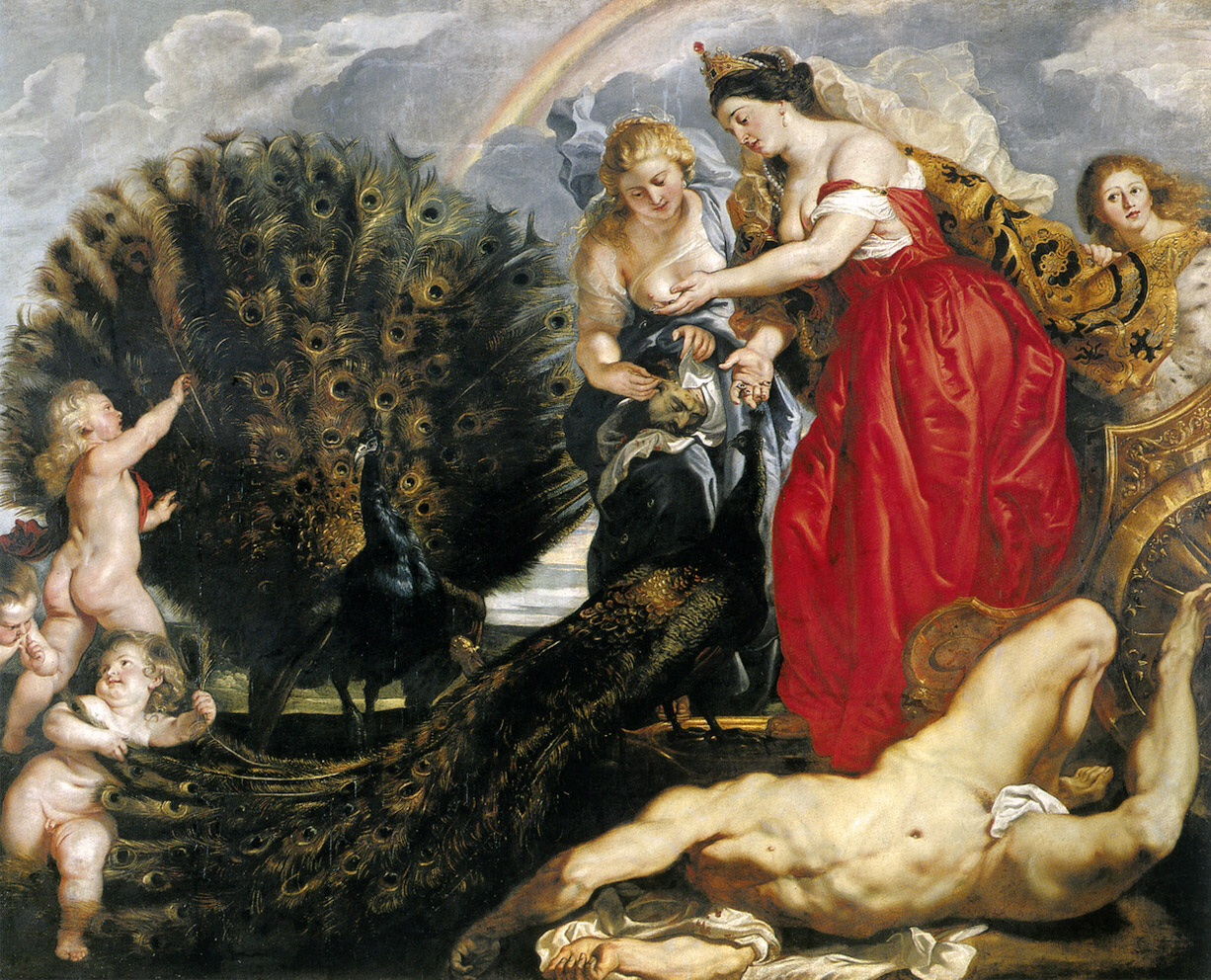
Juno and Argus, from about 1611, concentrates on what follows the killing of Argus. Juno, in red and wearing a coronet, receives the eyes taken from his severed head and places them on her peacocks’ tail feathers. Argus’ headless body lies twisted in the foreground, making the violence that preceded this act impossible to miss.
Rubens gives the scene a lighter visual beat as well: Juno’s left hand appears to rest beneath the breasts of the woman behind her. That small, mischievous gesture sits within a painting otherwise concerned with the aftermath of a mythic death. It asks the viewer to move between horror, ceremony and humor rather than read the scene as a single emotional register.

In Perseus and Andromeda, painted around 1622, the danger has passed and the reward is already taking shape. Andromeda stands unchained but nearly naked at the left, while Perseus claims her hand and receives a laurel crown. His winged sandals and polished shield identify the hero; the shield still reflects Medusa’s face and snake hair.
The painting brings together details that extend the story in different directions. A putto holds Hades’ helmet of invisibility, while Pegasus occupies much of the right side, drawing on another version of the myth. At the bottom, the dead sea monster Cetus marks the battle that has just ended. The result gives the viewer both a victory scene and a compact account of the events that made it possible.
Different scales, shared urgency

The Fall of Icarus is an oil sketch from 1636, presumed to have been developed into a finished painting by Rubens’ apprentice Jacob Peter Gowy. Despite its small size, it captures a sharply defined instant: Icarus drops past Daedalus, his wings in tatters and his arms raised as if he might still try to fly. His open mouth and eyes convey fear, while his twisting body makes the fall feel uncontrolled.
Daedalus remains airborne, his wings still working, but turns toward his son in alarm. Far below them, people occupy a bay beside a fortified town on the coast. Their presence gives the fall a destination: Icarus is about to strike the earth. The painting’s small format doesn’t lessen the separation between the two figures; it makes the difference between their fates all the more immediate.
Large compositions and crowded action

In The Rape of Proserpina (1636–38), Rubens combines parts of Ovid’s account into a forceful, rightward surge. Pluto struggles to lift Proserpina into his chariot while Minerva tries to stop the abduction. Pluto’s bulging eyes fix on Minerva, giving his face a strained intensity. Beneath the chariot, Proserpina’s scattered basket of flowers records the quiet activity interrupted by the attack. Two winged Cupids prepare to drive the black horses once the pair are inside.
Here, as in The Fall of Phaeton, scattered objects preserve an earlier moment while the figures carry the action forward. That combination gives the scene its narrative density: the viewer sees both the struggle at its height and the evidence of what was happening just before it began.

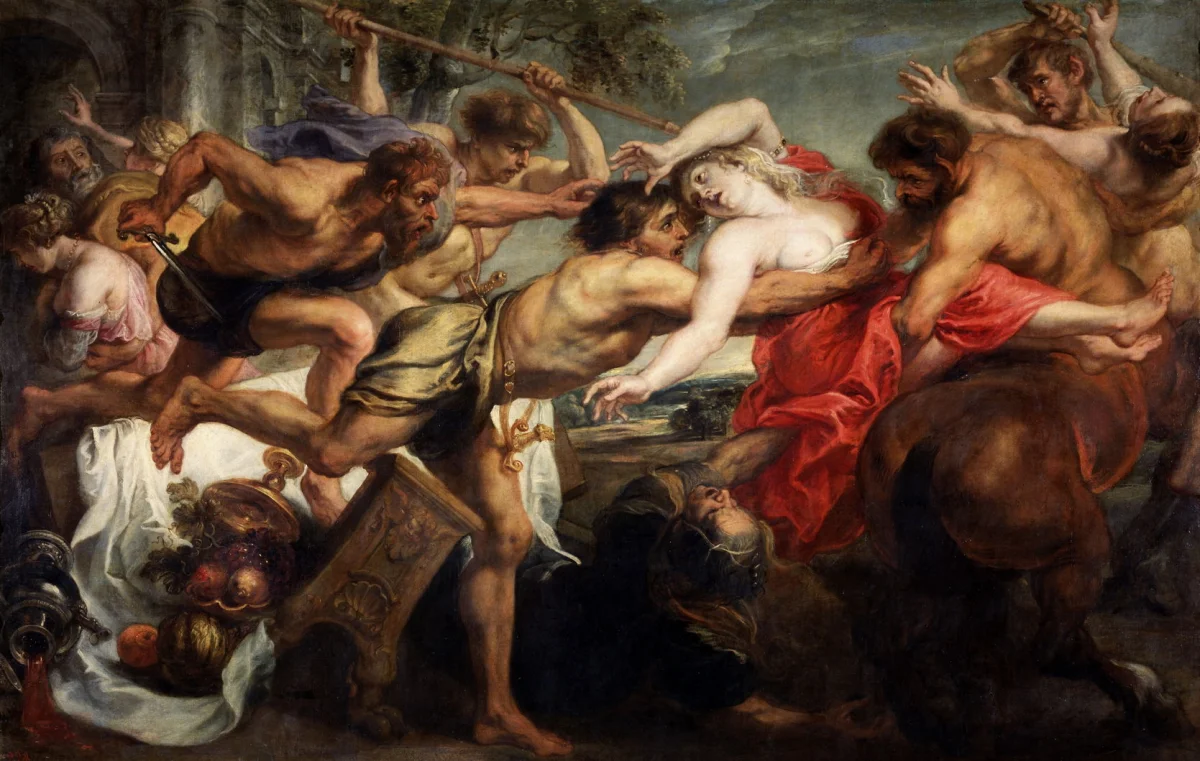
The Rape of Hippodame (Lapiths and Centaurs), also painted in 1636–38, applies similar energy to the wedding feast where the Lapiths fight the centaurs. At the right, Eurytus carries off Hippodame as Theseus prepares to rescue her from the centaur’s back. On the left, Lapiths attack with weapons; farther behind, another centaur tries to seize a woman.
The figures’ expressions sharpen the conflict, especially the Lapith at the left bearing a sword. Food and furniture tumble at the lower edge, linking the struggle to the feast it has disrupted. Rubens makes the surrounding disorder part of the story rather than mere background.
A quieter story, still poised for action

Susanna and the Elders, painted between 1636 and 1639, brings the same attention to timing to a religious story. The elders climb over a low wall as Susanna sits on her clothing and tries to cover herself with a dark cloak. Her small dog runs toward the men, perhaps warning her that she has been seen. Details at the lower left refer to the interruption of her toilet.
Rubens chooses an early point in the encounter, before the elders make their proposition. The scene therefore holds on the moment when Susanna recognizes the intrusion, while its next turn remains uncertain. Across these works, that control of timing is central to Rubens’ narrative skill: a single painted instant can carry a past event, an unfolding crisis and a consequence still to come.