Fontainebleau Forest and the Painters Who Made Trees Their Subject
From Corot to Renoir, artists used Fontainebleau’s trees and rocky clearings to test plein air methods and shift landscape painting toward brighter, more direct observation.
Fontainebleau’s forest offered 19th-century painters more than a scenic backdrop. Its old trees, exposed rocks and shifting light became subjects in their own right, and a place to work outdoors from direct observation. The Barbizon School takes its name from a nearby hamlet, but its artistic territory was the much larger forest that drew painters from France, Britain and the United States.
Covering about 250 square kilometres south-east of Paris, Fontainebleau is mixed deciduous woodland, much of it ancient. A royal castle stands at its centre, and French kings and Napoleon used the forest as a hunting ground. That history appears in paintings as well as landscapes: François Flameng’s scene of Napoleon hunting sets a stag hunt against the trees at sunset, making the wooded setting part of the drama.

The forest’s pull on landscape painters began before the Barbizon group was established. Achille Etna Michallon was among the early artists to paint there outdoors. In The Fallen Branch, Fontainebleau, from about 1816, a huge broken limb lies across the ground with a strangely animal-like presence. The choice of a fallen branch as the central motif points toward the later painters’ interest in ordinary features of the forest, rather than idealised views alone.

Richard Parkes Bonington brought a British perspective to the same terrain during a short visit around 1825. His In the Forest at Fontainebleau gives particular attention to the rocks, whose varied forms and paint handling suggest he may have begun the work in front of the subject. Such studies made the act of looking part of the painting: the forest’s irregular details could shape the composition instead of being tidied away.

Camille Corot helped make Fontainebleau a serious working ground for French landscape painters. He first painted there in 1822, then returned in earnest in spring 1829 after spending years in Italy, where he had studied outdoor painting in the Roman countryside. His Fontainebleau Forest (The Oak), from about 1830, shows how close attention to one tree could carry a whole composition. Carefully worked trunks and limbs give the oak weight and age; more open patches in the canopy let Corot describe the leaves in detail.

Corot was followed by Théodore Rousseau, Constant Troyon, Jean-François Millet and Paul Huet, with Charles-François Daubigny and Henri Harpignies among the later visitors. Many of their works were made in the forest, though the exact locations of few paintings have been established. Harpignies’s Fir Trees in Les Trembleaux, near Marlotte, painted in 1854, is a clear example of the outdoor practice. The site sits at the forest’s edge, where the artist painted largely in front of the scene.

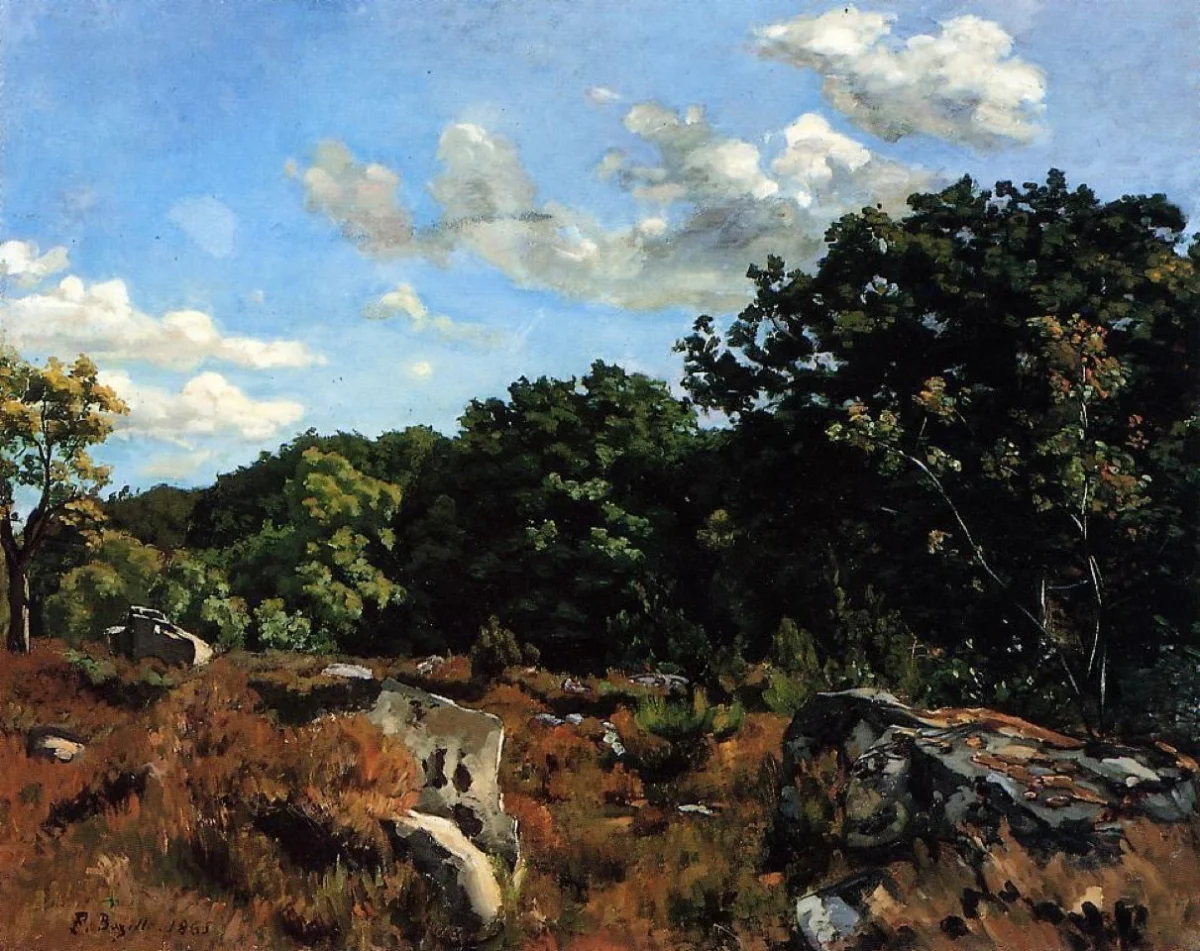
By the 1860s, a younger generation was testing the forest’s possibilities in brighter colour. In May 1865, Frédéric Bazille left Paris for Chailly and painted Landscape at Chailly with Claude Monet; Auguste Renoir and Alfred Sisley may also have been there. The influence of Barbizon remains visible, but Bazille’s stronger, lighter palette moves away from the sombre browns and greens common in earlier forest scenes.

Sisley, meanwhile, painted Avenue of Chestnut Trees in La Celle-Saint-Cloud in 1865, west of the forest, in a style still close to Barbizon landscape painting. The Salon refused the work when he submitted it in 1867. A year later, Sisley walked through Fontainebleau with Renoir and stayed in Marlotte, which also attracted Monet, Bazille, Camille Pissarro and Paul Cézanne. The village and forest formed a shared base for painters pursuing different approaches to the same terrain.

Renoir’s Jules Le Coeur and his Dogs in the Forest of Fontainebleau, painted in 1866, is a more unusual record of his working methods. He made two studies before the finished painting, and used a palette knife on all three. The technique and sequence suggest the work dates from before he returned to brushes around the middle of May that year. Here, a human figure and dogs share the scene with the forest, giving the landscape a social presence as well as a natural one.

The forest kept drawing painters after the Barbizon generation had changed landscape art. American artist Abbott Handerson Thayer, who trained in Paris, painted a loose oil sketch of Fontainebleau around 1876. Its free handling is described as the most Impressionist work of his career. John Ferguson Weir, another American trained in Paris and the first director of Yale’s School of Fine Arts, visited around 1902. In his Forest of Fontainebleau, a small solitary figure stands near a fallen trunk, giving the old trees a scale that a view without people might leave uncertain.


Across these works, Fontainebleau’s contribution is less a single style than a sustained opportunity to study nature at close range. Painters could focus on one oak, a fallen limb, a rocky clearing or a path through chestnuts, then carry what they learned into sharply different compositions. The forest’s lasting value for artists lies in that range: it rewards both careful description and a looser response to light, texture and form.