Albin Egger-Lienz: From Tyrolean Realism to a Looser Painting Style
Albin Egger-Lienz moved from detailed religious and rural scenes toward simpler, looser compositions shaped by Millet and Hodler.
Albin Egger-Lienz’s early paintings show an artist building a distinct style from close observation of Tyrolean life. Religious subjects, rural interiors and scenes of local history gave him material for detailed, often tightly composed work. By 1903, his brushwork had loosened and his figures had become simpler. That shift helps explain why his career merits attention beyond Austria, where he was once regarded as a major contemporary of Gustav Klimt.
Born near Lienz in the Austrian Tyrol, Egger-Lienz was named Ingenuin Albuin Troja. His father was a church painter and photographer; his mother was a farmer’s daughter. He learned to draw and paint from his father before receiving further instruction from other artists. In 1884 he entered the Academy of Fine Arts in Munich, where he remained until marrying in 1899 and moving to Vienna.
He arrived in Vienna soon after the Secession, but joined the conservative Künstlerhaus. He also kept returning to the Tyrol, spending long periods in the Ötztal and painting in the region during many summers. That attachment to place runs through the work: even when he painted religious or historical subjects, his settings and people often feel rooted in local experience.
Observation before simplification

Saint Sebastian, painted in 1887 while Egger-Lienz was still studying in Munich, treats the familiar martyrdom without theatrical excess. Its dark palette and comparatively objective approach point to a student interested in observed form as much as religious drama. Many of his surviving early works take up religious themes, but his attention to material details also carries into secular scenes.

The Gate, from about 1890, depicts the entrance to a grain store at Tammerburg, one of the old castles in Lienz. Its support, cardboard, and direct treatment of the scene suggest that Egger-Lienz may have begun it in front of the subject, though there is no known record confirming that he painted outdoors. The work gives a small architectural feature the weight of a carefully studied motif.

In The Church Choir of Lienz Parish Church of St Andrä (1890), strong perspective and carefully rendered detail organize a complex interior. The composition may recall Henry Lerolle’s large painting The Organ Rehearsal, shown at the Paris Salon in 1885. Its realism also places Egger-Lienz within the Naturalist current then gaining ground across Europe: the painting makes its subject convincing through the arrangement and specificity of what is seen.

Farm in Grafendorf, also dated 1890, turns to the hard conditions of rural work in Styria. A young woman churns butter on a stone platform inside a deteriorating barn. The contrast between the labor and its worn surroundings gives the scene a social dimension without turning it into a grand historical narrative.

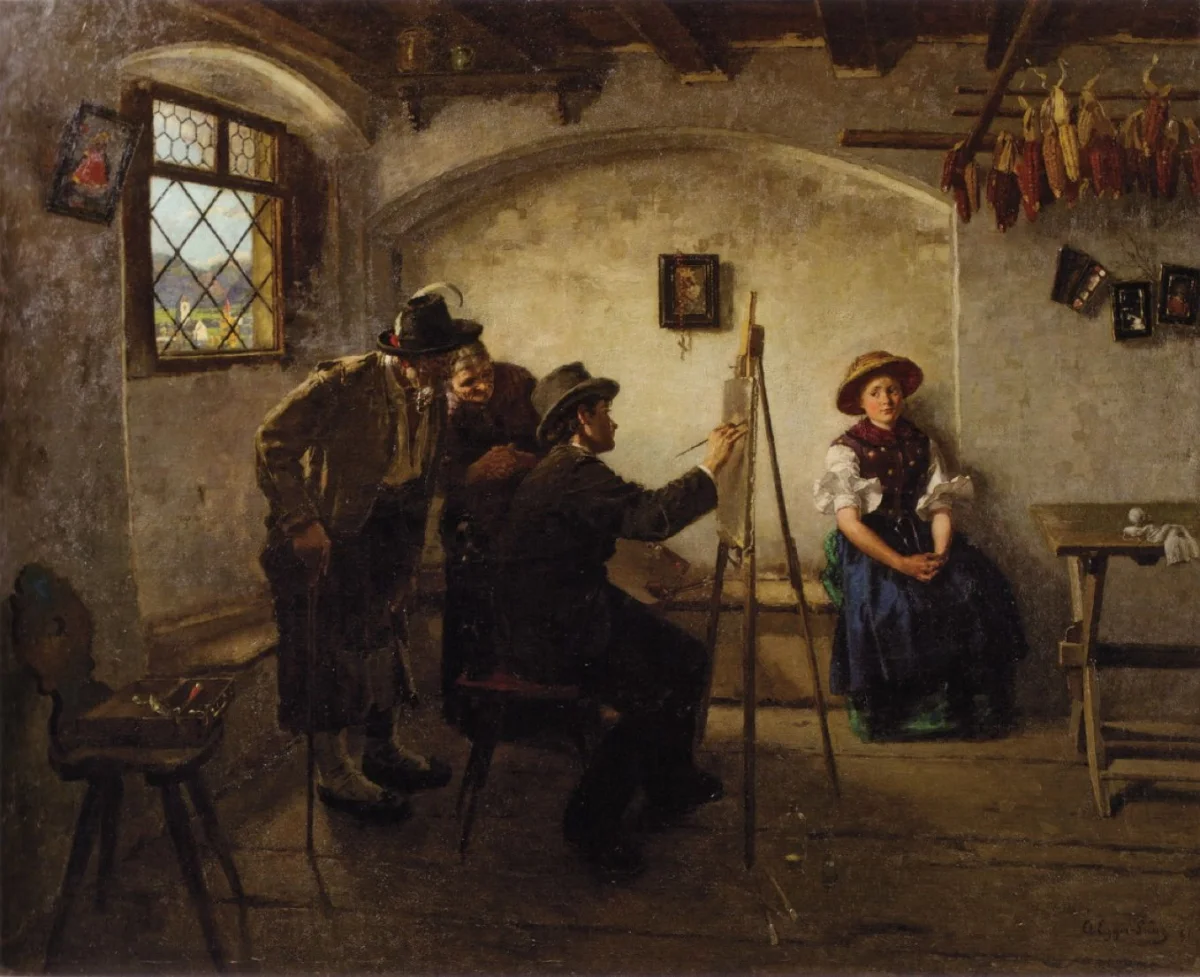
The Portrait Painter in the Countryside (1891) may depict Egger-Lienz himself at work, painting a young woman seated tensely to the right. That identification is an interpretation rather than a confirmed fact. A small view through the window places the scene somewhere in the Tyrol or perhaps Bavaria, tying the act of portraiture to the landscape around it.
History, portraiture and a changing hand

A Farewell in the Tyrol in 1809, painted between 1894 and 1897, makes history intimate. In a graveyard, an elderly man appears to mourn his wife. He clasps his hands in prayer while leaning, half-kneeling, on the muzzle of a locally made shotgun. The year in the title refers to a turbulent period: after Napoleon’s forces reoccupied Vienna and Austria lost at Wagram, much of the Tyrol was incorporated into the Illyrian Provinces, prompting popular uprisings.

The Cross, developed from 1898 to 1901, brought Egger-Lienz a Grand State Medal in Gold when it appeared at the Künstlerhaus in Vienna. It revisits the 1809 unrest through the figure of Tyrolean Capuchin priest Pater Joachim Haspinger, shown lifting a large crucifix amid a dense group of peasants. Scythes and a few old sabres make the crowd’s anger visible. The revolt failed; Haspinger fled to Switzerland, later returned to Austria and died in 1858.

The mood changes sharply in The Venison Dealer (1902). A young woman’s radiant smile stands out against a rich arrangement of game, though no venison is visible. The painting’s directness and warmth offer a counterpoint to the conflict and solemnity of the earlier historical scenes.

Christmas Eve (1903) recasts the adoration of the shepherds in what appears to be a Tyrolean cowshed, using light to make the scene feel immediate. Alongside The Tyrolean Waitress and The Sower, it marks a move toward looser handling. The waitress pours a drink while a pipe-smoking customer sits in the bright room behind her; a small black purse hangs from her belt. Everyday details remain, but the paint carries less of the earlier insistence on tight definition.


Jean-François Millet’s social realism is especially apparent in this early version of The Sower, a subject Egger-Lienz returned to later. Earthy colors, simplified forms and freer brushwork point toward the approach that would define much of his subsequent work. His first encounter with Ferdinand Hodler’s paintings in 1900 also marked a turning point, though Egger-Lienz disliked being treated as Hodler’s follower and considered him a competitor. The useful thread through these works is not a single influence, but the artist’s steady shift from exact description toward stronger, simpler forms.