Benjamin West: The American Painter Who Built His Career in Britain
Benjamin West’s career shows the promise and limits of history painting, from the vivid Wolfe scene to works that lost out to more accurate rivals.
Benjamin West’s career turned on a tension he never quite resolved: he wanted to make history painting speak to his own time, yet his strongest works often depended on clear staging and dramatic light, while his accounts of recent events could stray from the facts. Born in Pennsylvania, he spent most of his working life in Britain. His paintings show both the opportunities that came with that move and the cost of following a narrow path through royal patronage.
West was born in Springfield, Pennsylvania, in 1738. Wealthy Pennsylvanians sponsored his journey to Europe in 1760, hoping he would develop as a painter. He went first to Rome, where he spent three years studying the work of Anton Raphael Mengs and Gavin Hamilton. The city offered little of the narrative painting he sought. A painter drawn to landscape might have found inspiration in the Campagna, where outdoor oil painting was beginning to take shape, but West remained focused on history and religious subjects.
On the journey home in 1763, he stopped in London and stayed. He met the landscape painter Richard Wilson, then attached himself to Wilson’s student Joshua Reynolds. Reynolds would become a celebrated portraitist, but neither he nor the British art world around him offered West much guidance in the kind of large narrative compositions he wanted to paint. Angelika Kauffmann’s arrival in London in 1765 could have offered another connection to history painting, but West’s career developed elsewhere.
A modern subject, with an old visual structure
West’s best-known work, The Death of General Wolfe (1770), depicts the British commander’s final moments during the battle outside Quebec on 13 September 1759. Wolfe suffered three gunshot wounds and died soon after. The French commander, Louis-Joseph, Marquis de Montcalm, was also wounded and died the next morning. The British held their position; French forces withdrew from Quebec. The outcome helped bring much of France’s North American territory under British control.

The painting gives Wolfe’s death the gravity of a religious lamentation: the central group recalls a Pietà, turning a battlefield loss into an image of sacrifice. West’s decision to depict a recent event in contemporary clothing was striking, but the subject did not make the work entirely new. Its familiar, devotional structure helped viewers read the scene.
That structure sits uneasily beside West’s departures from the record. He included a Native American figure, though no First Nations people fought alongside British forces in this battle. For a scene so close to living memory, such invention weakened the painting’s claim to show history. West seems to have believed that avoiding classical dress was the radical choice; the more difficult task was balancing dramatic design with details viewers knew to be true.
Royal favour brought West steady work, but it also steered him away from the modern history subjects he had hoped to pursue. King George III appointed him royal historical painter. The appointment gave him financial security, while the king preferred classical subjects over recent events. West spent years on historical and religious commissions, including a large project for the Royal Chapel at Windsor that was never completed.
Where his storytelling worked
West did try other contemporary subjects, including The Treaty of Penn with the Indians (1771–72) and The Battle of La Hogue (1778), but their compositions were less successful. Religious narratives suited his ability to make a story legible through a small group of figures. In Isaac’s Servant Tying the Bracelet on Rebecca’s Arm (1775), a servant identifies Rebecca as Isaac’s intended bride by giving her jewellery after she offers water to him and his camels.

The two central figures carry the story without crowding it. A camel’s distinctly sour expression adds a dry note of humour. West’s clarity here points to a strength that his larger historical commissions sometimes obscured: he could make a complicated narrative readable when he kept the composition focused.
In 1778, West painted the death of the Earl of Chatham, a British political figure who had opposed American independence. Chatham collapsed in the House of Lords while arguing against a proposal to withdraw British troops from America. West, an American who had lived in Britain for fifteen years and worked for its king, had reason to find the event personally charged.

But a former protégé, John Singleton Copley, soon eclipsed West with a larger, more dramatic painting of Chatham’s collapse. Copley had been born in Boston in 1738, moved to London in 1774 and stayed there for the rest of his life. His version became the defining image of the incident, leaving West once again in the shadow of a fellow American working abroad.

West found a more distinctive solution in St Paul Shaking off the Viper, a preparatory work for an altarpiece commissioned for the Royal Hospital for Seamen chapel at Greenwich. Exhibited at the Royal Academy in 1787, it shows Paul surviving a snakebite on Malta. The saint rises above a crowd, the snake still attached to his hand. Firelight gives the scene urgency, and the unusual subject gives West room to build a strong composition without competing with a well-known account of a recent event.

Beyond the grand historical canvas
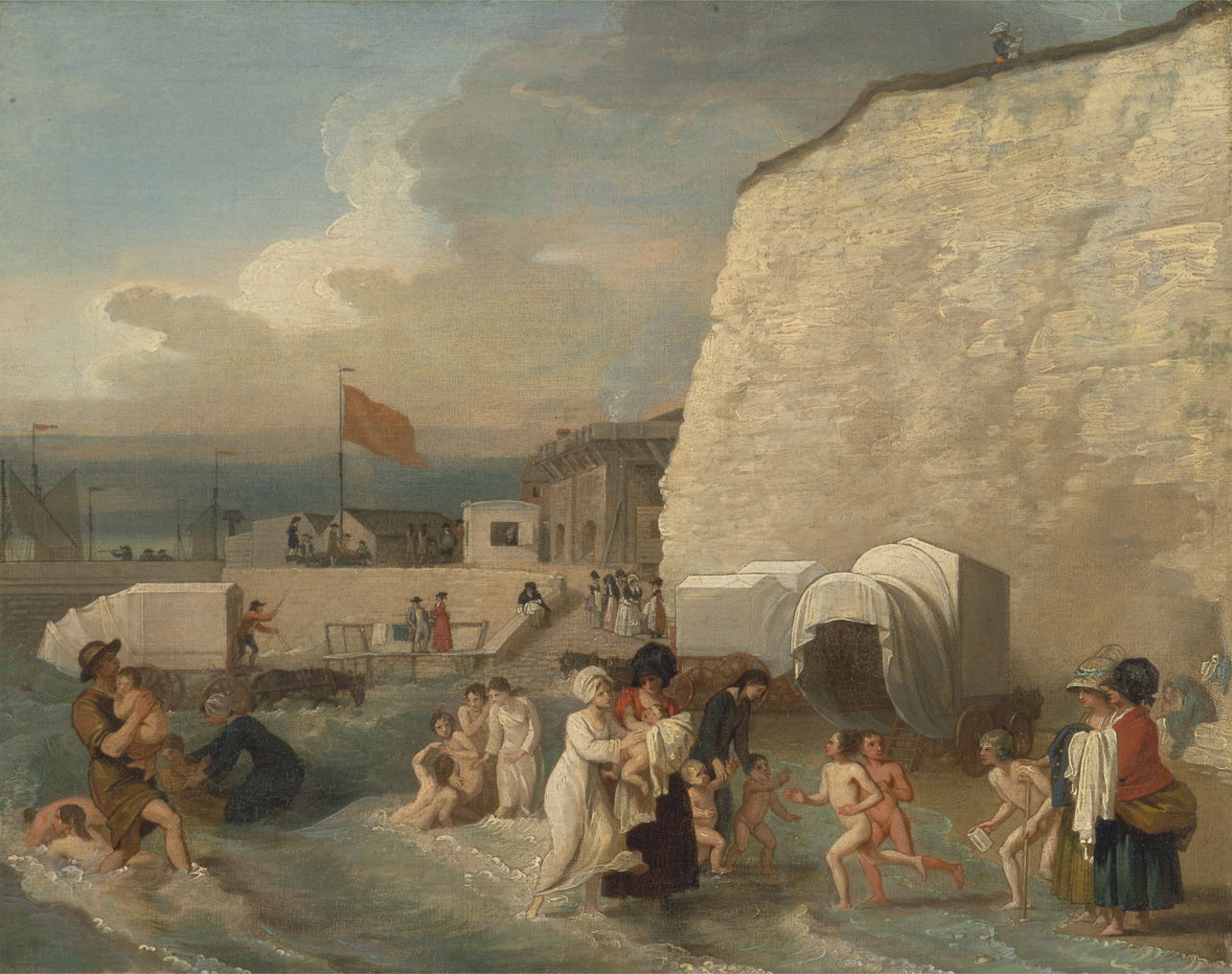
West’s less frequent landscapes suggest that his range was broader than his career choices allowed. The Bathing Place at Ramsgate, painted around 1788 for a print collection, depicts visitors entering the sea from covered, horse-drawn bathing machines. It records an everyday experience at a growing Kent resort, a subject far removed from kings, scripture and battlefield sacrifice.
The Expulsion of Adam and Eve from Paradise (1791) shows how effectively West could organise a larger religious scene. Made for the unfinished Windsor chapel project, it places the couple beneath the angel Michael and a blade of fire. West adds animals attacking one another: a lion strikes at horses, while an eagle descends on another bird. The violence extends the story’s idea of a world thrown out of balance, though the commission’s scale and setting kept West working within the subjects favoured by his patron.

In a much smaller work, Eagle Bringing the Cup to Psyche (around 1802), West turns to an episode from Apuleius’ The Golden Ass. Psyche must fetch water from the source of the rivers Styx and Cocytus, high on a cliff guarded by dragons. Jupiter sends his eagle to drive them off and collect the water. The compact painting isolates that intervention, giving West’s narrative skill a scale better suited to a single, decisive moment.

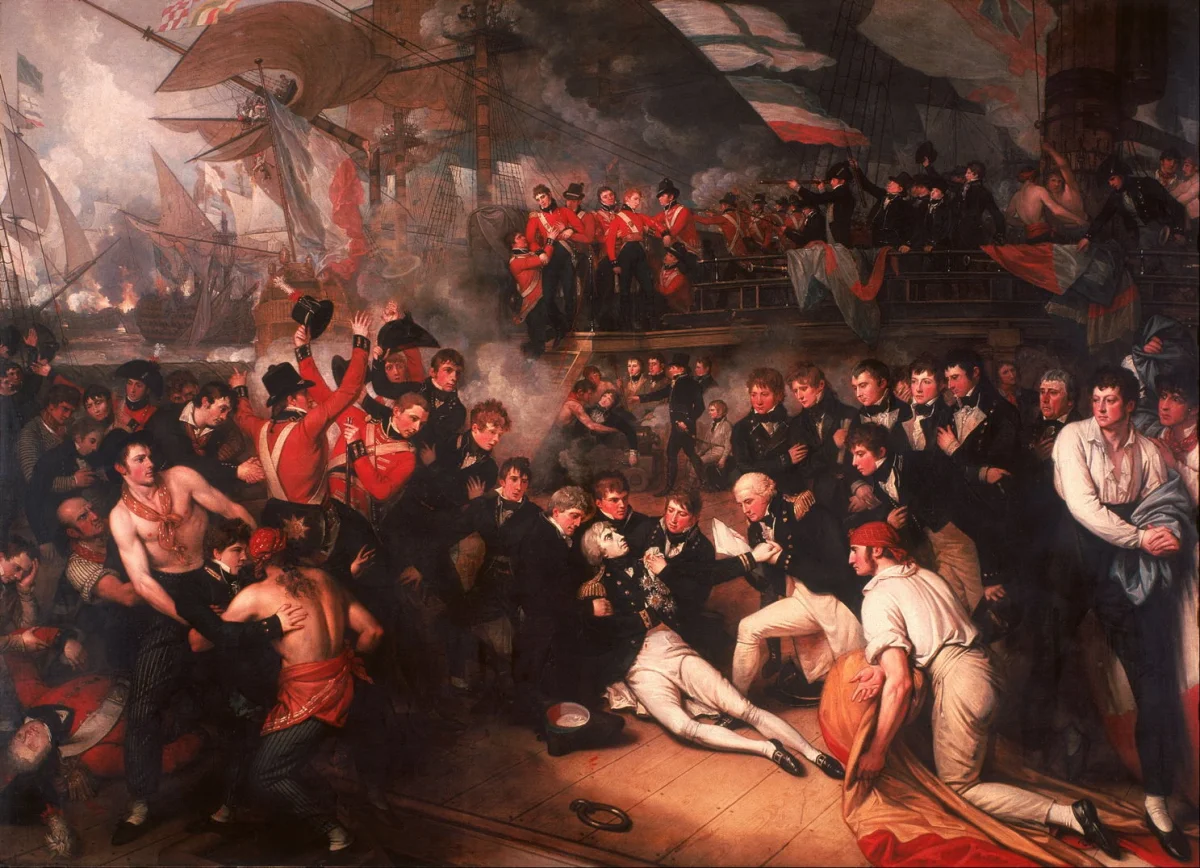
West returned to recent history with The Death of Nelson, completed in 1806, a year after the admiral died. The painting attracted a large audience when first shown in West’s studio, but its staging misrepresents where Nelson was when he died. Its public reception owed much to the subject’s popularity and the timing of its display. After West’s death, the Royal Naval Hospital at Greenwich declined the work, and Arthur William Devis’s 1807 painting became the better-known image of Nelson’s death.

His later portrait of Benjamin Franklin, Benjamin Franklin Drawing Electricity from the Sky (around 1816), offers another kind of history: an allegorical image built around Franklin’s famous electrical experiment. West presents the episode as a romantic vision rather than a literal record, a choice that suits the subject better than his attempts to reconstruct recent deaths.

West died in London on 11 March 1820 while serving as president of the Royal Academy. He was buried in St Paul’s Cathedral, alongside the remains of Reynolds and J. M. W. Turner. American by birth and British by career, he built a lasting reputation in the country where he had intended only to stop briefly. His most compelling work still points to the path he might have taken: keep the drama, but let the facts hold their ground.