Orestes, the Furies and the Art of a Family’s Revenge
Aeschylus’ Orestes story moves from a son’s revenge to a reckoning with the Furies, inspiring Greek pottery and later paintings.
Orestes’ story turns a family feud into a question with no clean answer: can a son avenge his father by killing his mother? Aeschylus makes that act the centre of the Oresteia, his three-play account of murder and its consequences. Artists returned to the myth across centuries, drawn to its tangled loyalties, its scenes of grief and its pursuit of Orestes by the Furies.

The tale has several versions. Aeschylus, Sophocles and Euripides all dramatized it, and Euripides wrote four plays connected to the story. The account here follows Aeschylus for Orestes’ return to Mycenae and the Furies’ pursuit, while other episodes draw on traditions used by Euripides and Racine.
A family divided by war
Helen, daughter of Leda and the Spartan king Tyndareus, became the wife of Menelaus. After Paris—also called Alexander—took her to Troy, Menelaus joined the Greek forces in the war to recover her. Their daughter, Hermione, remained in the care of Tyndareus.
Hermione’s marriage plans became another source of conflict. Tyndareus agreed that she should marry her cousin Orestes, son of Agamemnon, Menelaus’ brother. But during the war Menelaus promised her to Pyrrhus, also known as Neoptolemus, the son of Achilles. After returning from Troy, he enforced that arrangement, taking Hermione from Orestes.
Pyrrhus arrived with Andromache, the widow of the Trojan warrior Hector, whom Achilles had killed. Andromache’s young son Astyanax was also part of the story: accounts differ on whether Pyrrhus killed him during Troy’s sack or whether he survived and was taken with his mother. Hermione resented Andromache, and the hostility ran both ways. Hermione accused her rival of using sorcery to prevent her from having a child with Pyrrhus; Andromache mocked Hermione’s childlessness. Hermione began plotting to kill both Andromache and Astyanax.
Orestes came to see Hermione, and the two left together. He then sought Pyrrhus’ death, which would free Hermione from the marriage. Some tellings credit Orestes with killing Pyrrhus; others say Pyrrhus died at Delphi after violating the sanctuary. In either version, Hermione was free to marry Orestes. They had a son, Tisamenus, and later events brought Orestes back to Mycenae.
From Agamemnon’s death to Orestes’ revenge
Agamemnon’s own return from Troy ended in murder. While he was away, his wife Clytemnestra—Helen’s half-sister—had taken Aegisthus, Agamemnon’s cousin, as her lover. Together they killed Agamemnon and took power in Mycenae. Cassandra, who had returned with him as a concubine, was killed too. The accounts differ over which of the pair struck the fatal blow.
Aeschylus opens the Oresteia before Agamemnon’s return, with the expedition preparing to sail for Troy. To secure favourable winds, Agamemnon sacrificed his daughter Iphigenia. Clytemnestra and Aegisthus later killed him in revenge for that death and to secure the throne.
Years later, in The Libation Bearers, Orestes returned to avenge his father. He killed Aegisthus and Clytemnestra, his own mother. The third play, The Eumenides, begins with the Furies pursuing him, tormenting him for matricide. Their arrival shifts the story from revenge between relatives to the question of what can follow an act committed in the name of justice.
Other versions extend Orestes’ story beyond Aeschylus’ trilogy. In one account, he returned to Mycenae after Aegisthus and Clytemnestra had children, killed their daughter Helen and later their surviving son Aletes, then took the throne. He married Erigone, his half-sister. Hermione disappears from the account after returning to Sparta with Orestes; her fate is uncertain.
Ancient drama and later images
The Oresteia won first prize at the Dionysia festival in 458 BCE, and the family’s story continued to shape later drama. Among its notable descendants are Eugene O’Neill’s Mourning Becomes Electra and Jean-Paul Sartre’s The Flies. Greek artists also pictured episodes on pottery. After the Renaissance, however, the story became a less common subject; the source identifies an illustration from the late eighteenth century as the earliest post-classical artwork it could locate showing Orestes with the Furies.

Girodet’s The Meeting of Orestes and Hermione, made around 1800, shows Hermione on the right as Orestes approaches. A second woman, probably her maid, stands with him. The drawing was one of Girodet’s illustrations for Racine’s play, and its details hint at the danger beneath the meeting’s courtly appearance.
A table leg between the figures takes the form of a siren, not a Fury. It suggests that Hermione is drawing Orestes toward her. Her folded arms and reserved expression play against the exposed shoulder strap of her robe. Girodet presents her as a seductive, calculating figure, a reading associated with the versions by Euripides and Racine.

A decade later, Pierre-Narcisse Guérin depicted the pressure surrounding Pyrrhus’ household. In Andromache and Pyrrhus (1810), Pyrrhus sits on a throne while Andromache kneels beside him, clutching her son. Two other women face them. The figure on the right is likely Hermione, displaced from her forced role as Pyrrhus’ wife. The child is probably Astyanax, though accounts disagree on whether he survived Troy’s fall. In the version where he lived, Hermione’s plot against Andromache included the boy’s death.

Guérin’s Orestes Announces the Death of Pyrrhus to Hermione, from around 1810, draws on a scene developed in plays by Euripides and Racine. Orestes displays the sword used to kill Pyrrhus at Delphi. Hermione reacts with shock, as does the maid behind her. The image captures the moment when a plan to escape an unwanted marriage becomes an act of violence.
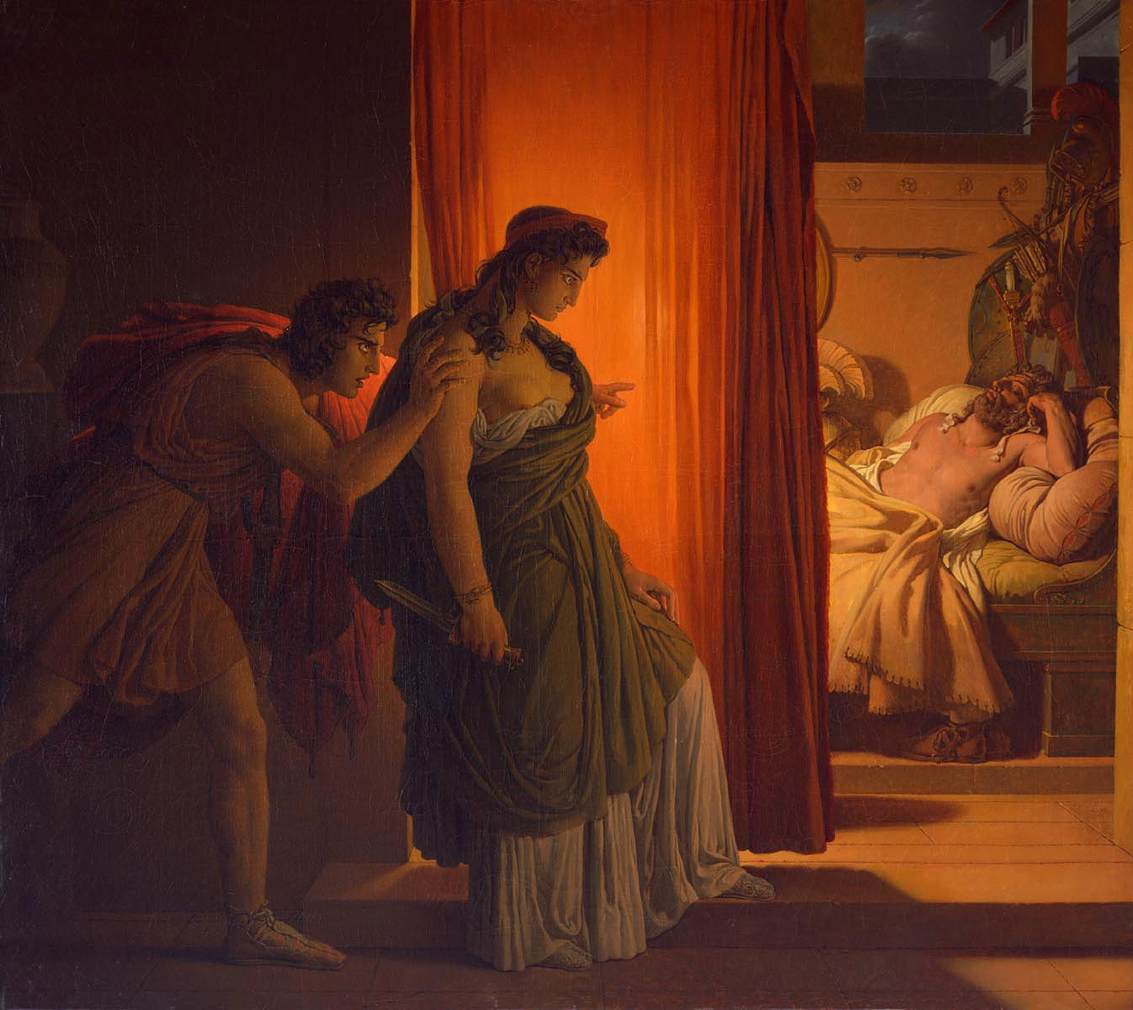
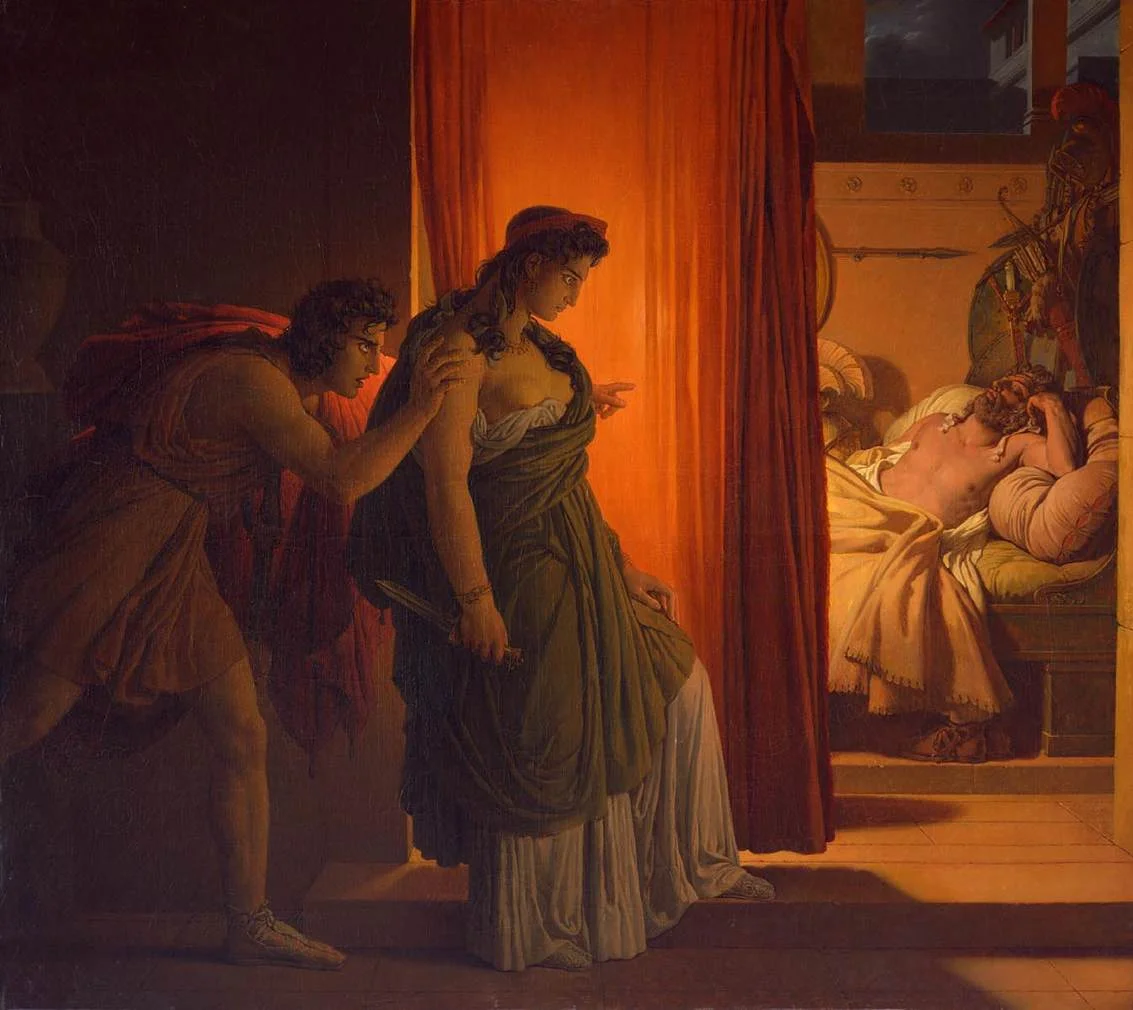
In Clytemnestra hesitates before killing the sleeping Agamemnon (1817), Guérin returns to the clearer, central crime of Aeschylus’ trilogy. Clytemnestra stands over her sleeping husband with a short sword. The pause implied by the title gives the scene its force: the murder is imminent, but the image holds on the instant before she acts.
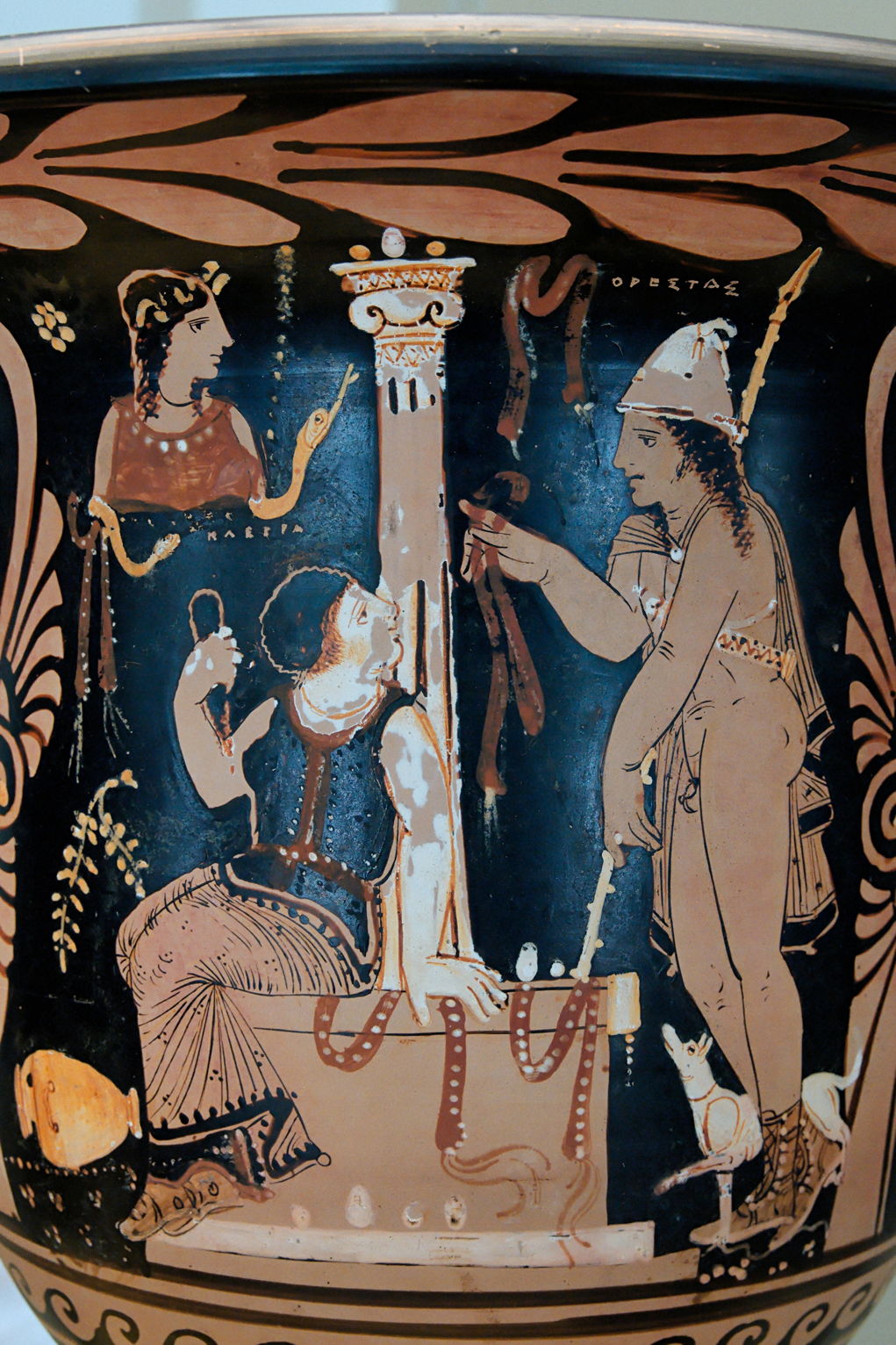
This Greek vase, dated to 340–330 BCE, shows Orestes meeting his sister Electra at Agamemnon’s tomb. The encounter became a recurring subject for later painters, linking the act of revenge to the siblings’ shared mourning.
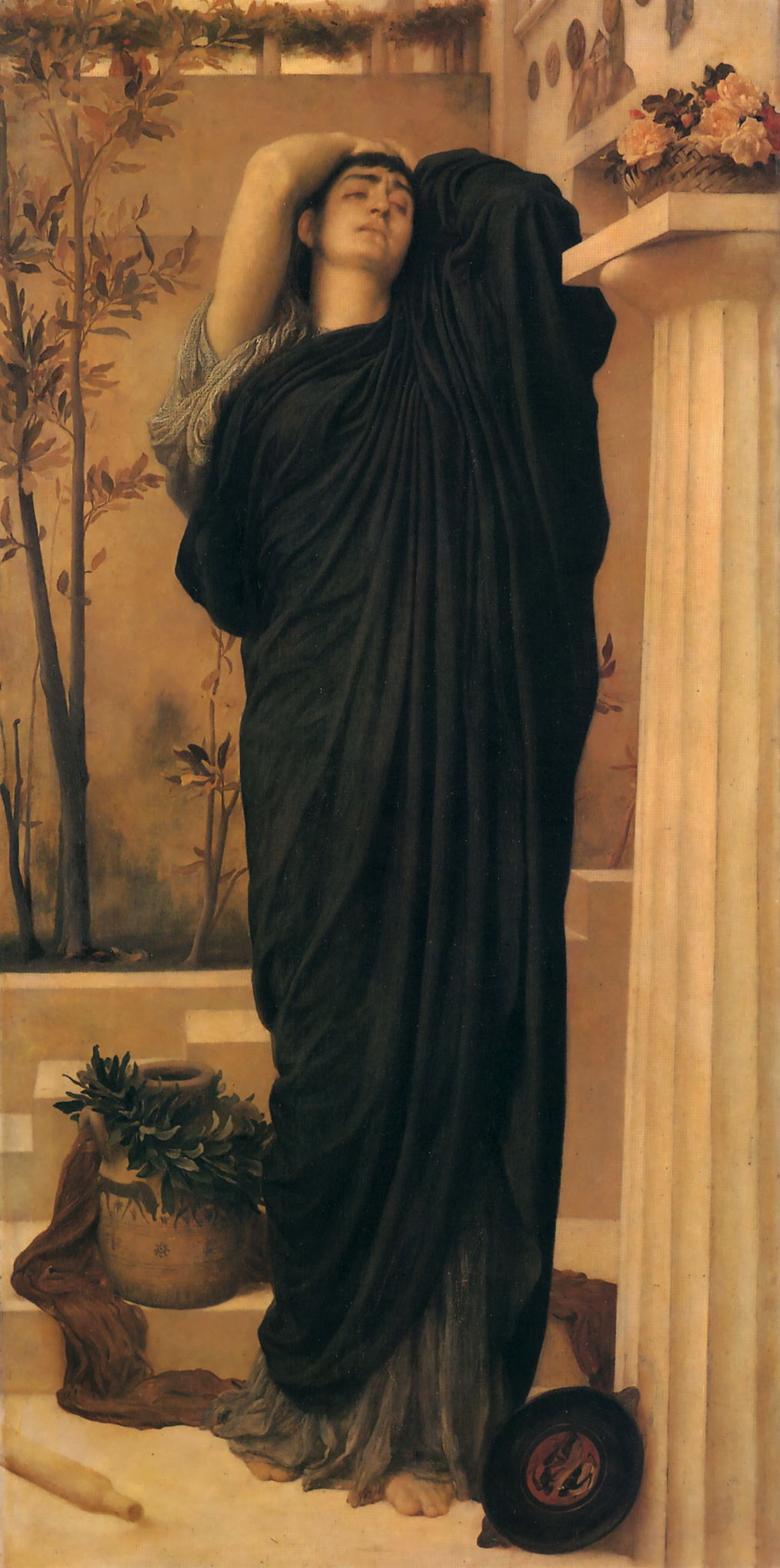
Frederic, Lord Leighton’s Electra at the Tomb of Agamemnon (1868–69) makes grief its subject. Electra wears black beside a large tomb, her eyes shut and brows drawn tight. She presses her hands against her head in a gesture that suggests the ritual tearing of hair. The stillness contrasts with the violence elsewhere in the myth.

A drawing made in 1859 after an undated krater in Naples shows Orestes seeking refuge at Delphi. At the upper left, a black Fury points a snake toward the figures. The pursuit that closes Aeschylus’ trilogy is already visible in this ancient image: Orestes can reach sanctuary, but the consequences of his mother’s murder follow him.
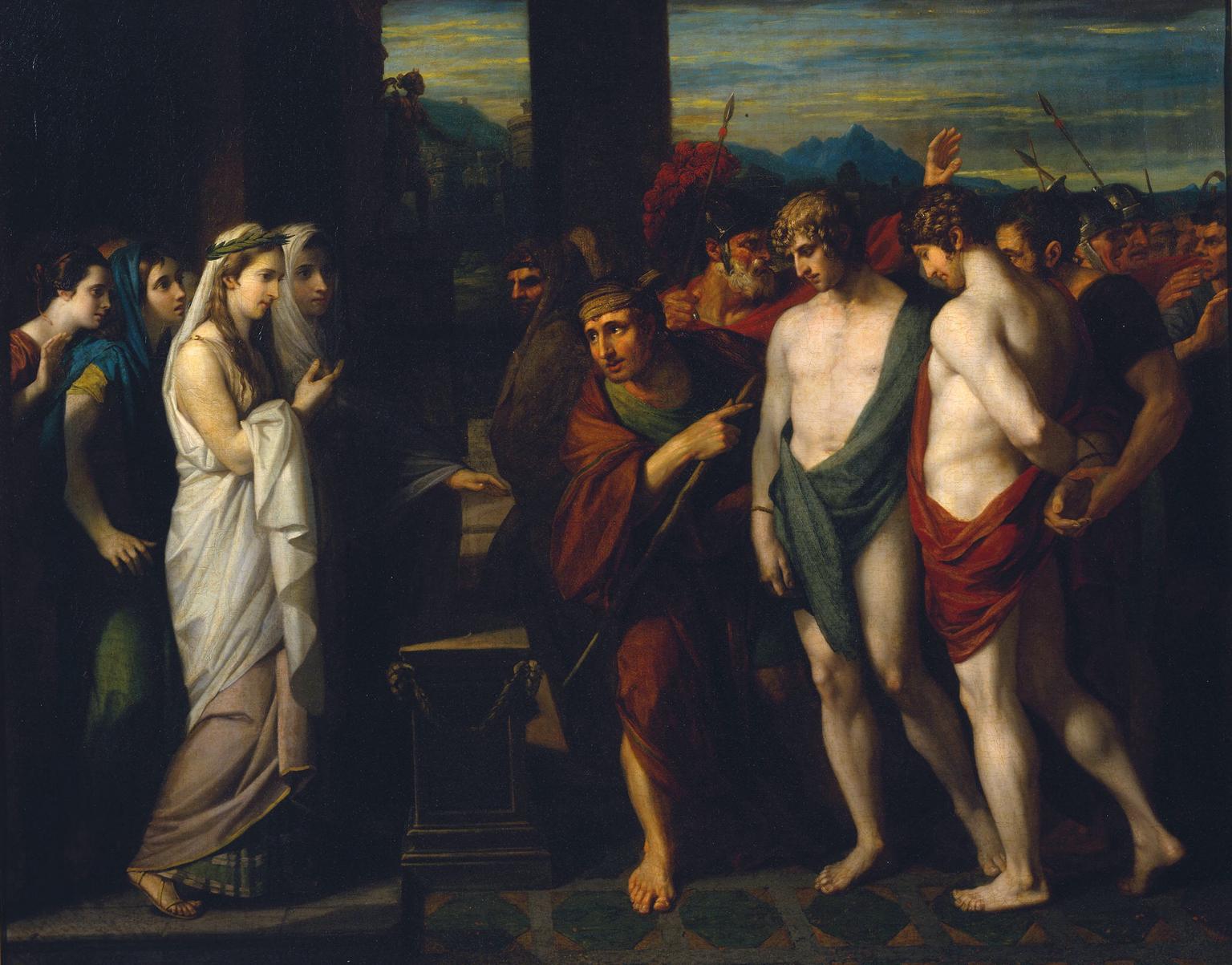
Benjamin West’s Pylades and Orestes Brought as Victims before Iphigenia (1766) shifts the story to the aftermath of Orestes’ crime. Orestes and his cousin Pylades stand in the foreground before Iphigenia, now a priestess of Diana. In this version, the oracle at Delphi had told Orestes to return Diana’s gold statue. His attempt to take it brings accusations of sacrilege, and the pair face sacrifice at the altar between them and Iphigenia.

An Apulian vase dated to 380–370 BCE shows Orestes being purified by Apollo, still holding the sword used in his murders. At the far left, Clytemnestra tries to rouse the sleeping Furies. The image leaves the story at its central impasse: purification may answer the crime, but the Furies have not yet stopped pursuing him.
===