Thomas Girtin’s Watercolours Show the Talent Turner Feared
Girtin reshaped British watercolour before his death at 27, moving from detailed architectural views toward compositions led by light, weather and water.

A rival who died at 27
Thomas Girtin’s career ended just as his watercolours were becoming more ambitious. He died in 1802, aged 27, leaving behind work that had already moved beyond careful records of buildings and places. In later paintings, architecture sits within a broader composition of sky, water and changing light. J.M.W. Turner, his friend and contemporary, understood the threat: “Had Tom Girtin lived I should have starved.”

Born in Southwark, London, on 18 February 1775, Girtin was the son of a prosperous brush maker. His father died when he was three. Girtin received drawing lessons as a boy, then began an apprenticeship in 1789 with Edward Dayes, a watercolour painter of views. That same year, Turner entered the Royal Academy Schools, gaining formal instruction instead of learning through a long trade apprenticeship. Their different starts didn’t prevent them from working together or influencing each other.

Rochester, Kent: from the North, probably made around 1790, already shows his feel for atmosphere. Its sky and receding distance give the view depth, although some scholars place the work a couple of years later.
From pen outlines to watercolour
By about 1792, Girtin had likely left Dayes’s apprenticeship. Engravings of his work were appearing in Copper Plate Magazine, and he adapted his technique to make his topographical views suitable for reproduction. In Kirkstall Abbey from the N.W., ink and wash still give the scene a defined, illustrative character.

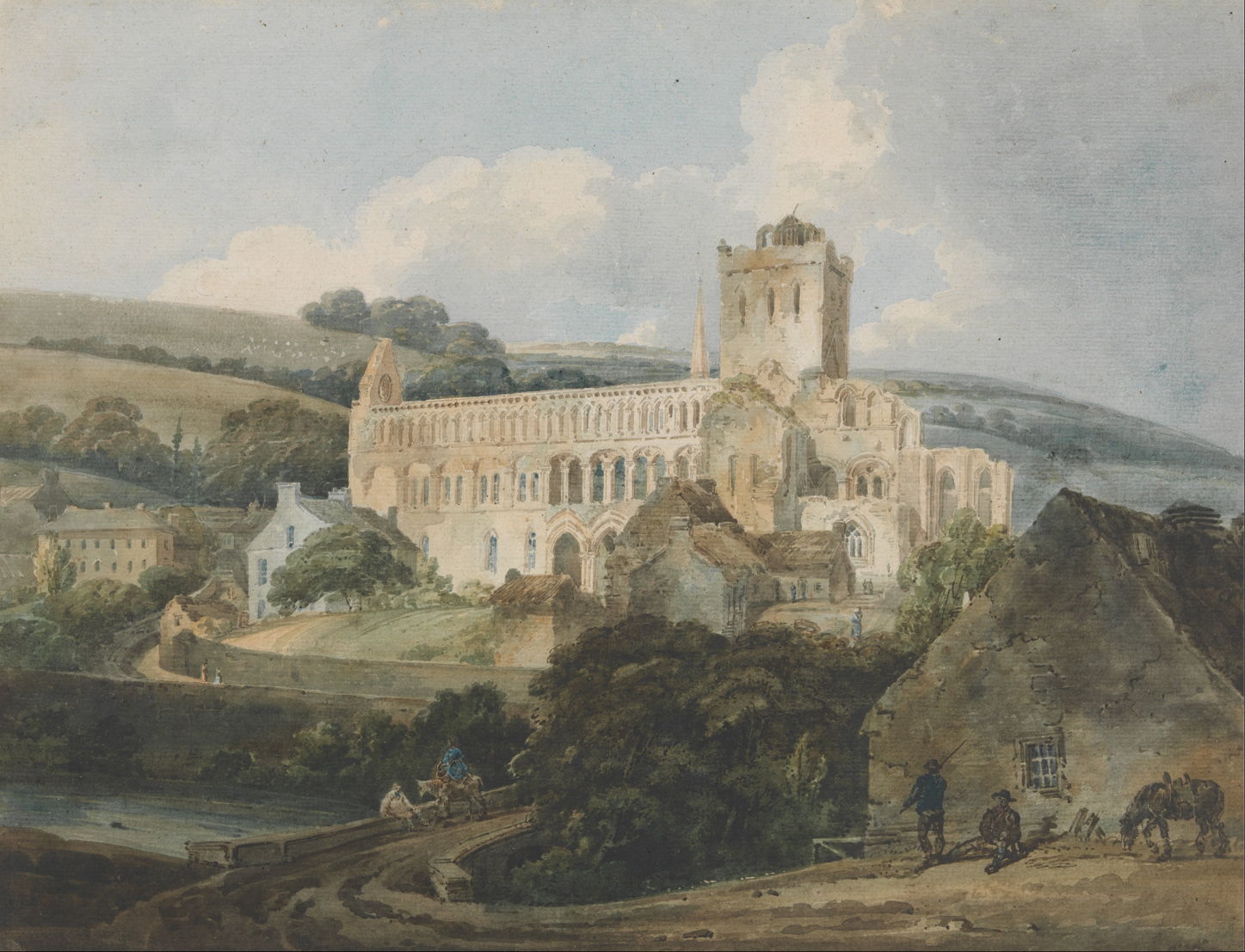
He began working for antiquarian James Moore the following year. In Jedburgh Abbey, Roxburghshire, ink retreats to details in the foreground, while watercolour takes on more of the work of describing the scene. It’s a small technical change with a larger effect: the image relies less on drawn outlines and more on the way colour and tone build a view.

Girtin’s first major painting tour with Moore took place in 1794. They travelled through the Midlands, visiting Warwick, Stratford, Lichfield, Peterborough and Lincoln. The resulting view of Lichfield Cathedral helped establish Girtin among the leading watercolour landscape painters of his time. That year, the Royal Academy also accepted his first painting for exhibition, a view of Ely Cathedral, now held at the Ashmolean Museum in Oxford.

Later in 1794, Girtin began receiving instruction at Thomas Monro’s home alongside Turner. The two became friends and influenced each other’s work. Girtin’s command of composition was already striking in Glasgow Cathedral, whose arrangement anticipates some of John Constable’s later studies of Salisbury Cathedral, made around 1830.


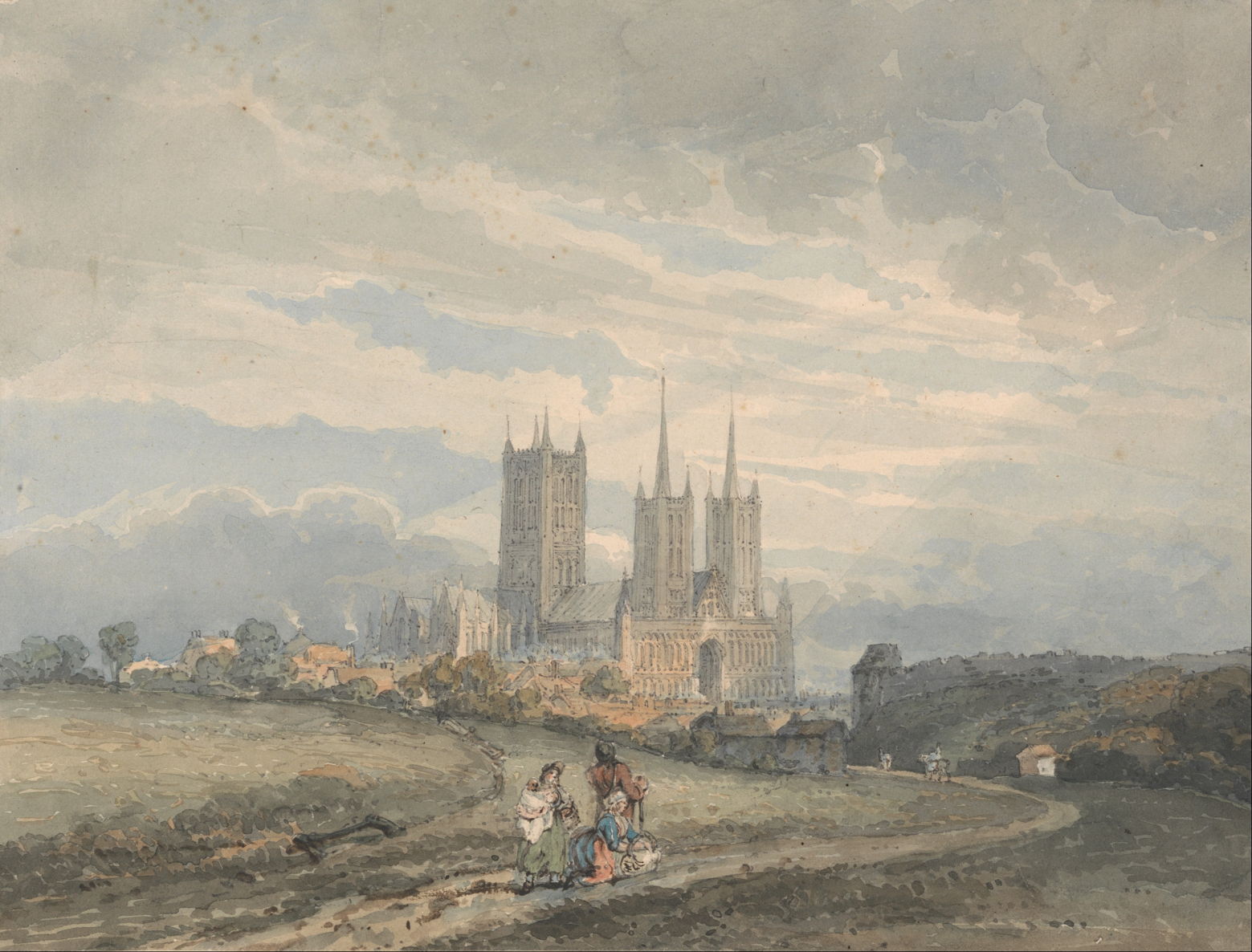
By Lincoln Cathedral, painted around 1795, the ink outlines and illustrative approach have nearly disappeared. The watercolour is beginning to carry the image on its own.
Light takes the lead
Girtin toured northern England and the Scottish borders independently for the first time in 1796. Sketches from the trip informed his later paintings, including Lindisfarne Castle, Holy Island, Northumberland. The island’s tidal causeway would have limited the time available to paint on site. Girtin completed the scene in his studio, drawing on sketches, notes and memory.

Ten of his watercolours from that journey appeared at the Royal Academy in 1797. They brought his first newspaper reviews, higher fees for commissions and growing patronage. Nine works were exhibited the following year, after a summer tour of North Wales. Six paintings based on that trip were praised when shown in 1799. Girtin had hoped to travel to Greece with Lord Elgin, but the position went to Neapolitan painter Giovanni Battista Lusieri. Instead, Girtin toured Yorkshire, where his attention increasingly turned to fleeting light and away from architecture as the main event.
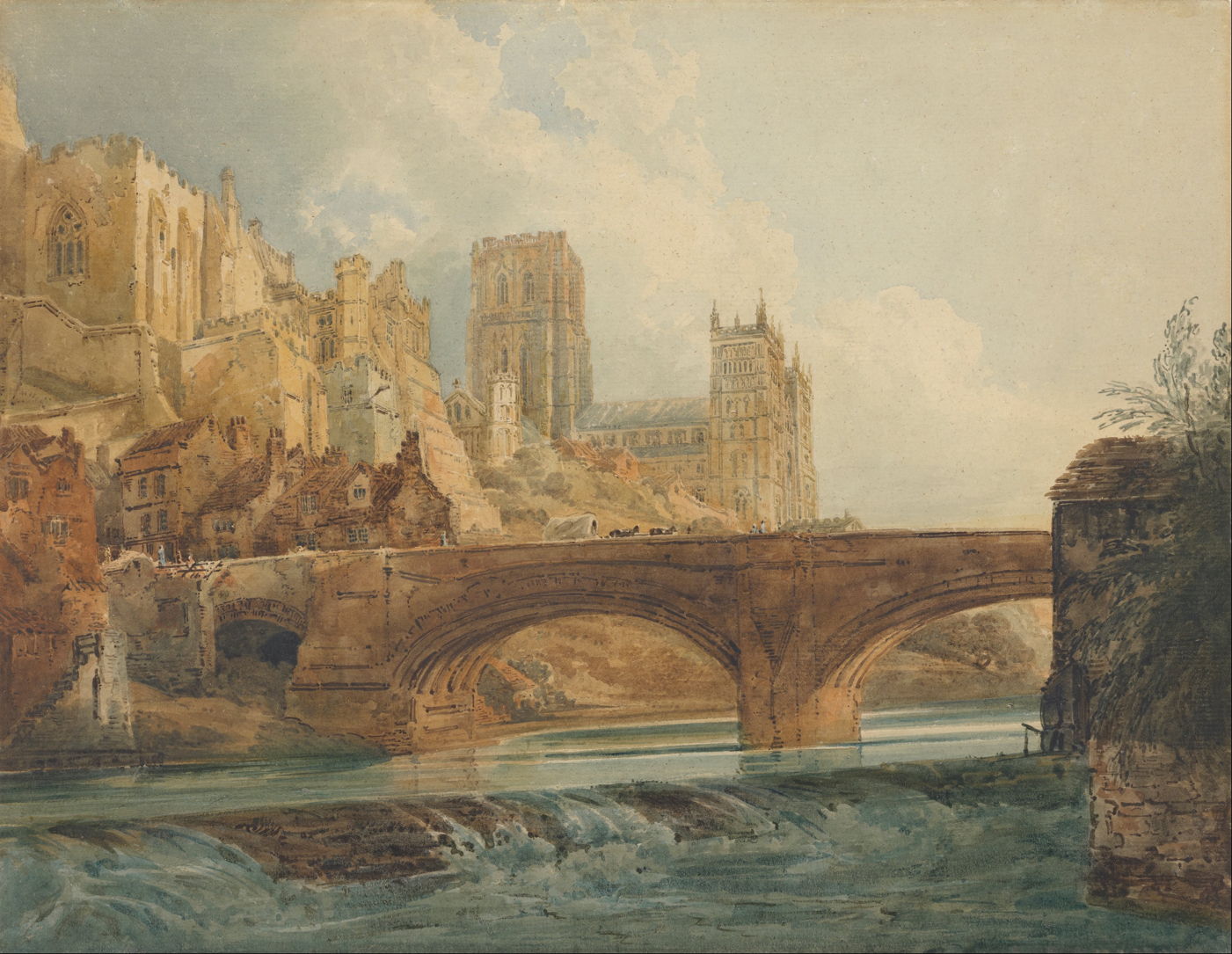
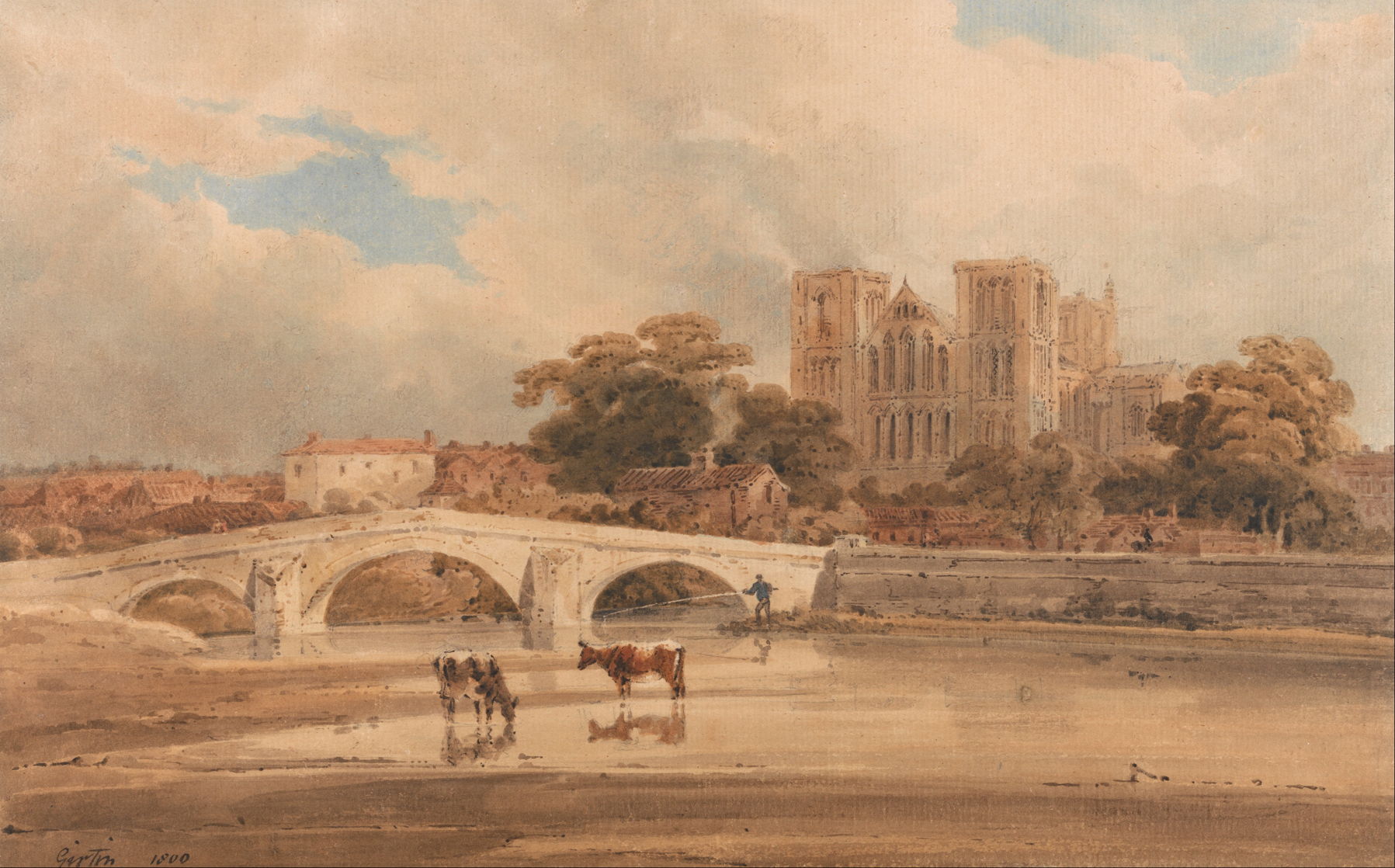
In Durham Cathedral and Castle, architectural detail remains plentiful, but it belongs to a unified scene rather than competing for attention. The brushwork in Jedburgh Abbey from the South East has left the pen behind altogether. In Ripon Minster, Yorkshire, the river, bridge, cattle and lone angler draw the eye before the large building does.
Girtin’s 1800 view of the Thames, The White House at Chelsea, makes the shift especially clear. The buildings are identifiable, but they don’t dominate. Sky, river surface and a passing effect of light on the white house shape the painting. That year he exhibited his last watercolours at the Royal Academy, toured Yorkshire and the Scottish borders, and married in the autumn.

The Village of Kirkstall, Yorkshire, completed in 1801 from earlier sketches, offers another carefully balanced scene, with an angler fishing from his cart in a ford. Girtin exhibited an oil painting at the Royal Academy that year, apparently his only exhibited work in the medium. It received strong praise, but is believed lost. After one final tour of Yorkshire, he spent the winter of 1801–02 in Paris.

A final experiment
In 1802, Girtin completed watercolours from his travels and made studies for Eidometropolis, a panoramic painting measuring 5.5 by 32.9 metres. He finished it in time for its London opening on 2 August. The project was a major financial gamble, and it appears not to have succeeded commercially. The panorama has since been lost.
A watercolour of Guisborough Priory, made after one of Girtin’s visits to North Yorkshire, has also been linked to an oil painting of the same subject at the Yale Center for British Art. The oil has been proposed as his sole surviving painting in that medium, but the attribution is disputed: some observers consider its execution too crude to be his.


Girtin’s health had troubled him for roughly a year before he died on 9 November 1802, probably during an asthma attack or from a complication of pulmonary tuberculosis. Turner’s broader training later supported work in other genres, but Girtin had been his closest competitor in watercolour landscape painting. The surviving works make the lost years tangible: he was already finding ways to make place, weather and light work as one, and his career ended before that direction could run its course.
References
Smith G (2002) Thomas Girtin: the Art of Watercolour, Tate. ISBN 978 1 854 37394 6.