Meta Details Open AI Networking Stack, From 102.4T Switches to MetaRoCE
Meta’s OCP Summit talks cover liquid cooled switches, multi plane fabrics, open platform software and networking across AI clusters.
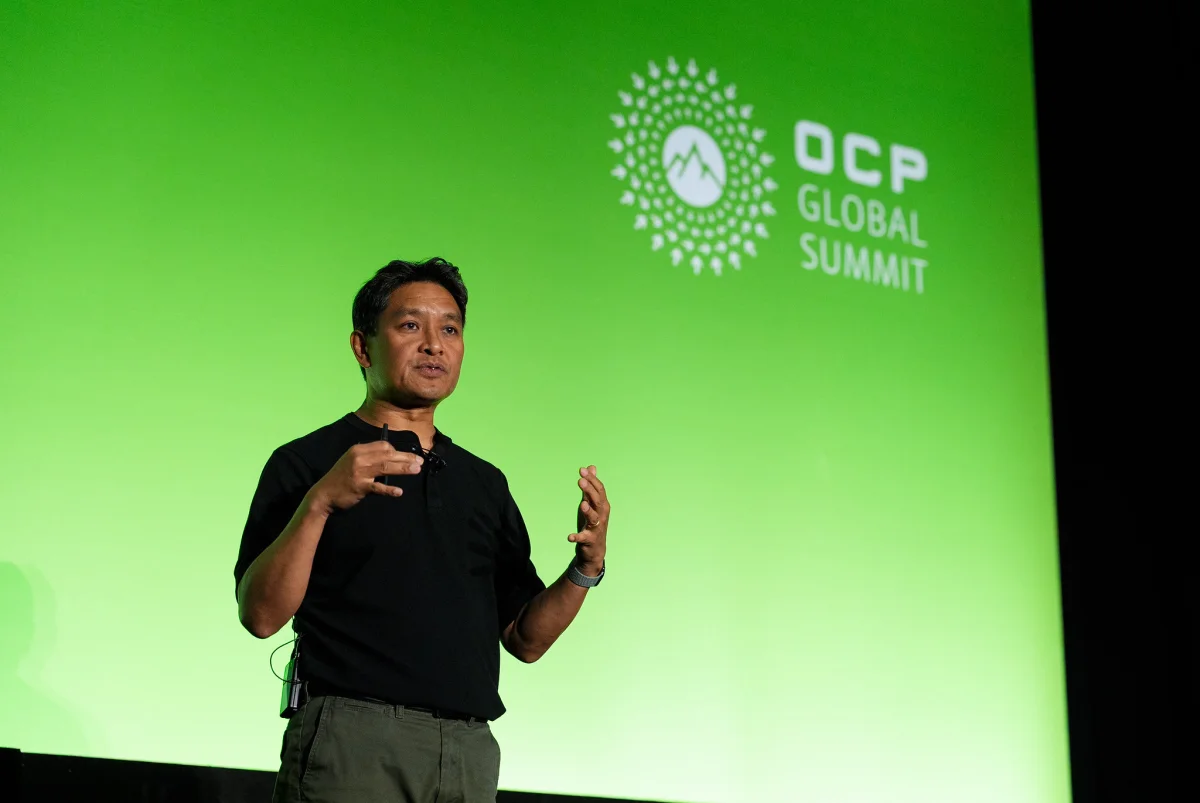
Meta’s networking plans for large AI clusters span the full path from accelerator links inside a rack to connections between regions. At the 2026 Open Compute Project (OCP) Global Summit, the company described new switch hardware, an open software initiative and network designs intended to connect its latest AI models, including Muse Wonder and Muse Spark, as well as the Prometheus gigawatt-scale cluster.
The announcements point to a practical change in how Meta is approaching network growth: links, switches, control software and validation all need to scale together. The company’s technical sessions, now available as recordings and slide decks, show where that work is progressing and where deployment questions remain.
Switch capacity and optics
Meta’s IcePack rack houses IceCube, a 102.4-terabit-per-second switch built around 128 800-gigabit Ethernet ports. IceCube and N-IceCube use a two-OU, hybrid liquid and air-cooled design without PHYs, and can use either Broadcom Tomahawk 6C or NVIDIA Spectrum-6 silicon. They run FBOSS, Meta’s network operating system. The design ties switch capacity to rack cooling and platform choices, rather than treating the switch chip as an isolated component.
Meta 102.4T Ethernet Switch (video) — Rongchun Zhou and Reza Niazmand describe the IceCube platforms.
Optics and short-reach links are another part of the cost and power picture. Meta’s session on integrated optics draws on validating 51.2T co-packaged optics and considers which lessons may apply to 102.4T systems. The questions include power, density, disaggregation and reliability. In a separate discussion, engineers examine linear pluggable optics, which remove a retimer DSP from each module. That shifts equalization and fault triage toward the host, so fleet reliability is a central question.
Integrated Optics at Scale: From 51.2T CPO Validation to Meta’s 102.4T (video) features Granthana Rangaswamy, Siamak Amiralizadeh and Xu Wang. Operating Linear Pluggable Optics at Hyperscale (video) features Amin Yekani and Qing Wang.
Meta also discusses deploying 800-gigabit-per-second active electrical cables, with component quality as a focus. Another session looks at what it takes to develop a near-package optics ecosystem for AI systems that may exceed the reach of pluggable modules.
Large-Scale Deployment of 800G AECs in Meta Data Centers (video) features Jingyu (Kevin) Yu and Abhijit Chakravarty. Beyond Pluggables: Building the NPO Ecosystem for Scaling AI features Nan Ge.
Software and a shared switch platform
Hardware flexibility depends on software that can support more than one vendor’s platform. Meta, Microsoft and Alibaba are co-leading OSPA, an OCP initiative to standardize the switch platform layer. The group has submitted its version 1.0 specification. Meta’s case for the work is that SAI helps make data-plane software portable, while platform services and board support can still require repeated, vendor-specific engineering.
Open Switch Platform Architecture (OSPA) — A Unified Network Switch Platform Reference Design (video) introduces the proposed reference design. The OSPA initiative describes its goal of a common platform layer.
Other sessions focus on production integration: combining NVIDIA Spectrum-X switches, its SDK, SAI implementation and simulator with FBOSS. Meta and NVIDIA describe a test-driven CI/CD workflow for joint integration. A separate FBOSS session covers routing, forwarding, platform services and board support, with configuration-driven qualification intended to help move platforms from initial board support toward readiness for the OCP ecosystem.
NVIDIA SDK + FBOSS: Building Production-Ready AI Network Fabrics (video) features Parvez Shaikh, Harish Krishnamoorthy, Alan Elder and Tom Zhu. Open, AI-Ready FBOSS: From Platform Bring-up to Solution Qualification (video) features Srikrishna Gopu and Benoit Sigoure.
Scaling beyond a rack
For scale-out, Meta describes a Flattened Planar Fabric in which each GPU connects to eight network planes. The design reduces the Clos fabric from three tiers to two, uses packet spraying at the network interface card, and combines host and switch control. Meta says it developed the approach with NVIDIA and shared it with its cloud partners. The practical question for operators is how the change affects fabric complexity and traffic management as clusters grow.
For scale-across, Meta’s Backend Aggregation (BAG) system acts as a petabit-scale super-spine, connecting buildings, campuses and regions in Prometheus. A separate regional backbone uses SRv6 on FBOSS with SAI. The sessions address distance management, platform fit, reliability and capacity planning, as well as how the data and control planes operate across wide-area links with shallow buffers.
Scaling AI Infrastructure Across DC and Beyond: Meta’s Journey with BAG (video) covers the architecture and deployment experience. SRv6 Powered Backbone Networks (video) describes the backbone implementation and its path from concept to deployment over a matter of months.
Meta’s operational view connects networking to the rest of the training stack: GPUs, scale-up links, FBOSS, drivers, communication libraries and the scheduler. The company also describes applying lessons from on-premises GPU deployments to cloud capacity. A cross-industry panel considers what routing and optical transport need to support clusters spanning multiple sites.
High Performance at Scale and Reliability by Design: Operating Meta’s Largest AI Clusters (video), Bridging On-prem and Cloud: GPU Networking at Meta Scale (video) and the Scale-Across Networking Panel (video) explore those themes.
Ethernet scale-up and transport
Within racks, Meta’s Tahan is an Ethernet scale-up switch for the MTIA 300 system, based on Broadcom Tomahawk 5. Meta also previewed a design connecting 72 accelerators per rack using 102.4T silicon. The ESUN initiative, short for Ethernet for Scale-up Networking, has released version 1.0 and is progressing toward version 1.1. The sessions cover performance characteristics, ecosystem validation and testing.
Tahan: An Open, Ethernet-Based Scale-Up Switch for MTIA (video), ESUN: Open Ethernet for the AI Scale-Up Era (video) and Validation Methodologies for the ESUN Ecosystem (video) cover these efforts. The ESUN initiative and its version 1.0 specification provide further detail.
At rack scale, thousands of copper connections make link quality a statistical concern: even a 99.9% yield can leave roughly 10 faulty links. Blind-mate cartridges also limit access to individual connections. Meta’s proposed test methodology treats this as a system-level yield problem, rather than a series of unrelated troubleshooting cases.
Test Methodology for Multi-Accelerator Copper Scale-up Interconnect (video) features Yao Rong and Karthik Ganesan.
MetaRoCE addresses the transport layer for AI workloads. When all-reduce and all-to-all operations depend on the slowest node, transport behavior can affect the pace of a large training job. Meta says it is open-sourcing its software implementation, starting with the user-space libsoftmetaroce; a DPDK-based version is planned next.
MetaRoCE: Rethinking RDMA for AI (video) discusses the transport specification. MetaRoCE in Software (video) covers the implementation.
What to watch next
The summit material lays out a broad engineering program, but the next useful evidence will come from deployment: how the optics choices compare in fleet operation, how shared platform standards reduce bring-up work, and how scale-across links behave as capacity and distance increase. The recordings and slide decks are available through the 2026 OCP Global Summit site.
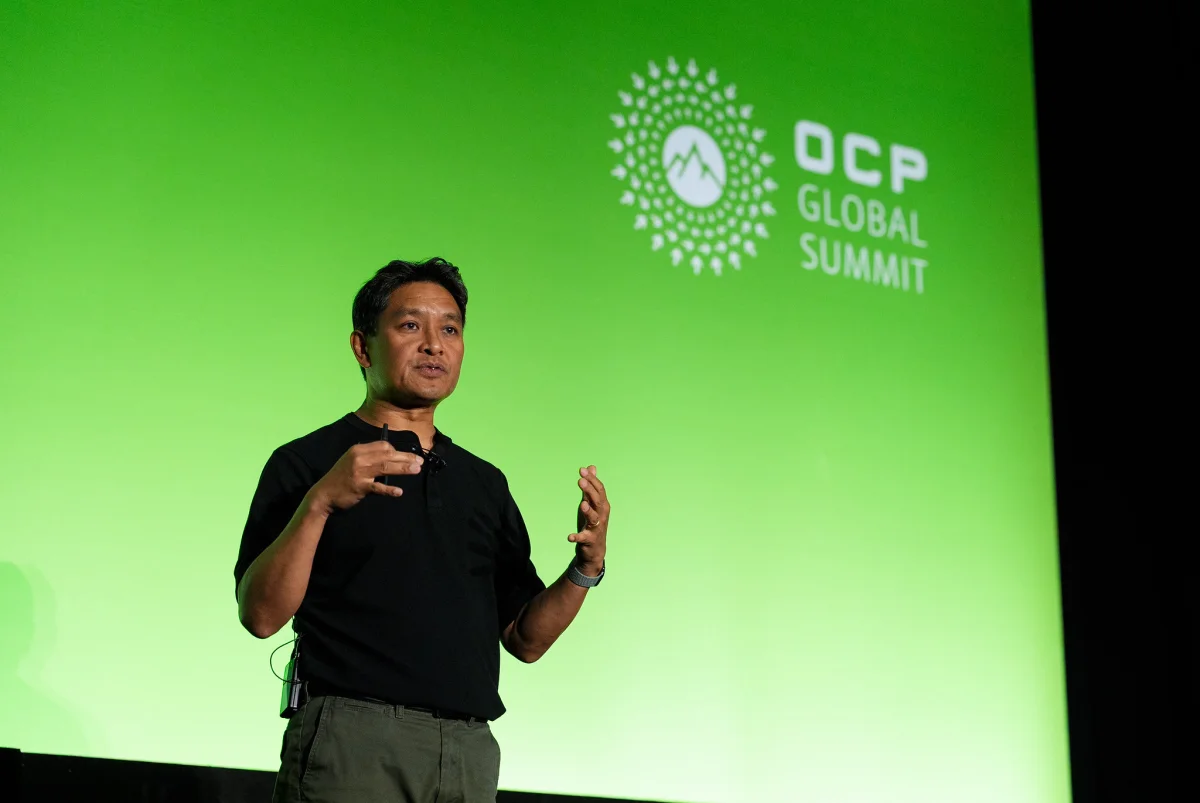
Concrete to Code: Engineering AI Infrastructure at Gigawatt Scale (video) features Meta infrastructure head Santosh Janardhan. Betting on the Network: Meta’s Case for Full-Stack, Open AI Networking (video) features Omar Baldonado. Breaking the Walls: Open Scale-Across for the AI Era (video) brings together speakers from Meta and Cisco.