James McNeill Whistler: From Thames Nocturnes to the Peacock Room
Whistler fused European painting with Japanese influence, reshaping portraiture and turning an ambitious London dining room into his best-known design.
James Abbott McNeill Whistler made his career in Europe, but his art resisted a tidy national label. He painted London’s river and working waterfront in muted tones, borrowed from Japanese design, and provoked arguments about what painting should do. The Peacock Room, his most famous decorative work, grew out of that mix of ambition and experimentation—and out of a dispute with the patron who commissioned it.
From Lowell to Paris
Whistler was born in Lowell, Massachusetts, in 1834. His family moved to Saint Petersburg in 1843, where his father worked on the railway to Moscow. Whistler later claimed during a London libel trial that he had been born in Saint Petersburg, explaining that he “did not choose to be born in Lowell.” He studied at the Imperial Academy of Fine Arts from age 11. After his father died of cholera, he attended West Point from 1851 to 1854, then learned etching while working for the US Geodetic and Coast Survey.
He left the United States for Paris in 1855 and studied at the Gleyre Academy. There he encountered the work of Gustave Courbet, whose influence can be seen in Whistler’s early willingness to use loose, direct brushwork. A set of etchings made during a walking tour of Alsace-Lorraine and the Rhineland in 1858 drew a positive reception. He also became known for his stylish dress and appetite for social life.

Head of Old Man Smoking and Old Mother Gerard, both painted around 1858, show how readily he departed from the polished finish expected in academic painting.

London, the Thames and white-on-white painting
Whistler settled in London in 1859 and kept a studio there until 1892. His paintings of the Thames made the city’s riverfront a recurring subject. The Thames in Ice records the severe winter conditions of 1860; later, friendships with the Greaves brothers helped direct his attention to views along the river.

His portrait Symphony in White No. 1: The White Girl (1862), with Joanna Hiffernan as the model, tested viewers in a different way. A woman dressed in white stands against a white background, leaving tone, shape and pose to carry the image. The Royal Academy rejected it. When Whistler showed it at the Salon des Refusés in Paris the next year, it appeared alongside Édouard Manet’s Déjeuner sur l’Herbe and met a similarly scandalized response.


In 1864 his widowed mother moved in with him, curbing some of his social excesses until she left in 1875. Whistler also developed ties with the Pre-Raphaelites and continued to draw on Japanese art. Henri Fantin-Latour and Félix Bracquemond had introduced him to Japonisme during his Paris years; both remained close friends.
Japanese influence in a London setting
The Princess from the Land of Porcelain (1863–65) brings those influences together. Christine Spartali, of Greek origin and sister to artist Marie Spartali Stillman, wears a kimono in a Western manner and holds a fan. A Japanese screen and a blue-and-white carpet complete the setting. The painting was shown at the Paris Salon in 1865 and sold, then returned to Whistler in 1867. It later became the visual centre of the Peacock Room.

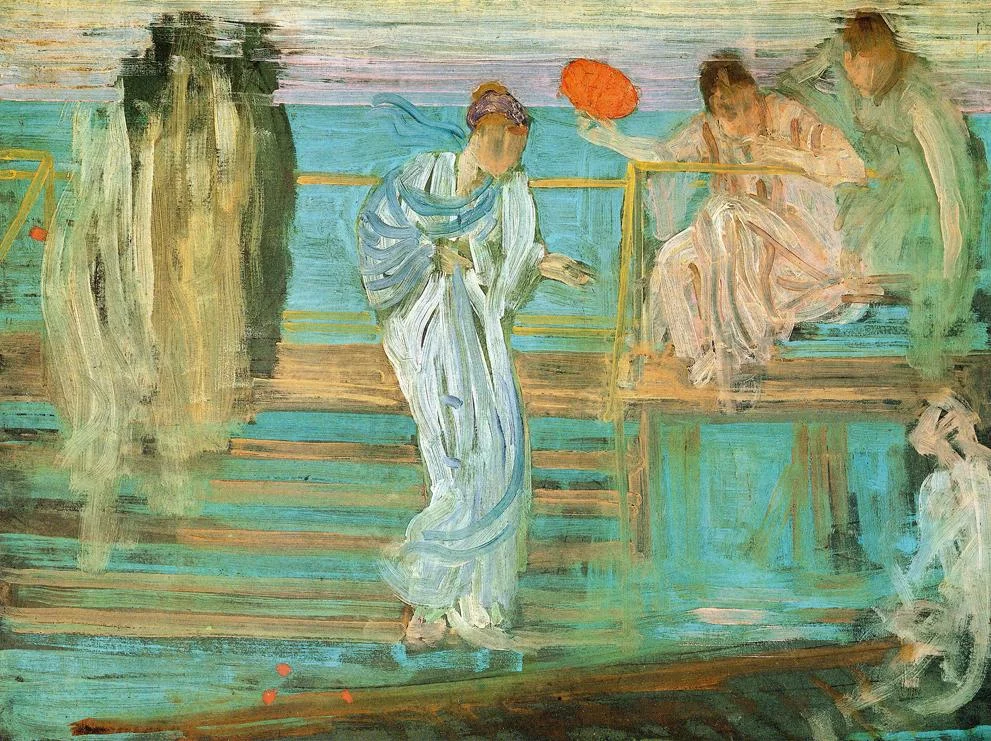
In Variations in Flesh Colour and Green — The Balcony, painted between 1864 and 1879, Japanese influence shapes the lower part of the composition. Behind it sit the grey warehouses and factories of the Thames. That combination is characteristic of Whistler: decorative pattern meets the modern city.

Whistler travelled to Brittany in 1862 and spent the following winter in Paris. In 1865 he painted at Trouville with Courbet, producing Crepuscule in Opal: Trouville. The next year he went to Chile, where he kept a detailed journal and continued painting while staying clear of the conflict then involving Spain. His visit brought him close to the Americas again for the first time since leaving in 1855. After returning, he painted Symphony in White and Red, around 1868.


Nocturnes, patrons and a costly courtroom fight
From 1871, Whistler began painting nocturnes along the Thames. Variations in Pink and Grey: Chelsea is one example. That same year he painted Arrangement in Grey and Black No. 1, now widely known as Whistler’s Mother. The Royal Academy initially rejected the portrait before displaying it in an unfavourable spot. France acquired it in 1891; it is now at the Musée d’Orsay.

Whistler declined an invitation to show in the first Impressionist exhibition in Paris in 1874, possibly on Fantin-Latour’s advice. After his mother moved to Hastings for health reasons in 1875, he again entertained lavishly. The next year, Liverpool shipping magnate Frederick Richards Leyland hired him to decorate a dining room in his London mansion.
The Peacock Room grew beyond the initial brief. Leyland had engaged architects to remodel the interior and shape the dining room in the Anglo-Japanese style. Whistler was working on the entrance hall when he proposed small changes to that room. With Leyland away, the revisions expanded until Whistler had transformed the entire space around The Princess from the Land of Porcelain. Leyland returned to find a much larger intervention than he had commissioned. The two men argued bitterly and ended their relationship, costing Whistler an important patron.
Leyland’s heirs sold the room’s contents in 1904. They were moved to the United States and went on public display at the Freer Gallery in Washington, DC, in 1923. The episode captures a recurring tension in Whistler’s career: his drive to control the whole visual experience could produce striking results, but it could also overrun a client’s expectations.
In 1877, eight of his paintings appeared in the opening exhibition of London’s Grosvenor Gallery. Nocturne in Black and Gold: The Falling Rocket drew a fierce response from critic John Ruskin. Whistler sued him for libel and won, but received only a farthing—0.6 pence—in damages. The legal costs bankrupted him in 1879. He went to Venice for a year, where he was commissioned to make etchings.

Late recognition and an international career
Back from Venice, Whistler returned to portraiture, including Harmony in Pink and Grey: Portrait of Lady Meux (1881–82). His work faced growing competition in London from John Singer Sargent, who moved his portrait studio there from Paris in 1886.

Whistler’s Venice etchings were shown at the Fine Art Society in 1883. In 1884 he visited St Ives, Cornwall, with his assistant Mortimer Menpes and artist Walter Sickert, painting small seascapes. Back in London, he made several pictures of shop fronts. Reviews improved, and in 1886 he became president of the Society of British Artists.

A one-person retrospective at London’s Goupil Gallery in 1892 brought him critical success. He moved to Paris for two years and increasingly concentrated on lithography. From 1898 to 1901 he taught at an art academy in Paris founded by former model Carmen Rossi; the artist Gwen John was its most notable student. Whistler died in London in 1903 and was buried there.
His story sits alongside other American artists whose careers crossed borders. Winslow Homer’s stay in the English fishing village of Cullercoats in 1881–82 helped shape his watercolour practice before he returned to the United States. Sargent, born in Florence to an American family with roots in Philadelphia, spent much of his career in Europe, especially London, while later spending more time in the United States. Whistler’s art likewise shows how much a career can be shaped by movement between places: the Thames, Japanese screens, Parisian exhibitions and the Peacock Room all became part of an identity that simple national labels can’t explain.