Open-Source Hardware Turns Small PCB Projects Into Gifts Hackers Keep Using
From SAOs to dev boards, shared hardware builds community and earns a place on the workbench through practical use and personal connection.
Open-source hardware has a useful advantage that’s easy to miss when focusing on schematics and board layouts: a finished design can become a gift. A small circuit board can carry an idea from one workbench to another, where someone else can learn from it, put it to work, or build on it. That exchange brings practical value and a personal connection that a generic board rarely offers.
Why small boards make good gifts
Small Add-On boards, or SAOs, fit that role especially well. They can be inexpensive to produce, easy to hand out, and still leave room for a designer’s personality. Their size also makes them approachable projects: building one can introduce the full path from circuit design through PCB production without requiring a large device or a costly run.
[Tom]’s Ode to the SAO points to that mix of learning and generosity. A maker can share the finished boards, while recipients get something tangible to use or inspect. The exchange tends to go both ways: people who give SAOs often receive designs from others. So the appeal isn’t simply giving something away. It’s joining a community where people trade ideas in a form that can plug in, light up, or invite another round of tinkering.
That makes the SAO a modest but effective format for participation. A design doesn’t need to solve a large engineering problem to be worth sharing. It can be a compact expression of a person’s interests, a demonstration of a technique, or an excuse to try a circuit at small scale. For recipients, the board becomes a point of entry: they can use it as intended, study how it was made, or treat it as a starting point for a variation.
Familiar boards can change what engineers reach for
That personal connection can matter even when a board’s job is more utilitarian. A workbench with a few microcontroller boards ready to hand makes quick experiments easier. A known, working board saves the time of choosing and setting up a new platform whenever a small application needs to be tested.
Two examples are the Raspberry Pi Pico clone made by high-school students at Hack Club and [CNLohr]’s ch32v003fun board and esp32s2-funprog programmer. These are tools made by fellow hackers, and they can win a place on the bench alongside commercial options. The reason is partly practical: a development board is useful when it’s available at the moment a project calls for it. It’s also personal. Knowing who designed or built a tool can make it more appealing to pick up and use.
That preference doesn’t mean a community-made board is automatically the right choice for every project. Engineers still need to consider the chip, interfaces, programming setup, documentation, and fit with the task at hand. But when a board meets those needs, familiarity and the story behind it can tip the decision. In daily work, tools aren’t chosen only from a specification sheet; access and trust shape what people actually use.
Making enough to share
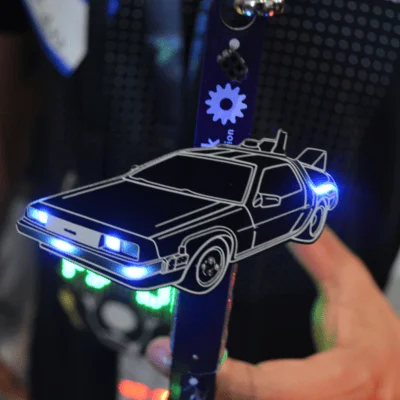
The same principle scales from a few boards on a desk to a conference badge made for hundreds of people. Hackaday’s Supercon badge prototype is being produced in a run of 1,000. The event’s sponsors help cover production costs, making a larger and more ambitious design possible than the organizers could fund from their own budgets alone.
That support changes what the badge project can attempt, while keeping its central purpose familiar: give attendees hardware they can take away and engage with. A conference badge can be a device to explore, a reminder of the people and projects encountered at the event, and a shared object that starts conversations. For its makers, producing a thousand copies also turns an individual design into a collective experience.
There’s a practical tradeoff in any such run. A design intended for many recipients has to be manufacturable at the planned scale and useful enough to justify the effort of producing it. The source doesn’t detail the badge’s circuitry, features, or production process, so those specifics are still unknown here. What it does make clear is the role of outside funding: it lets the team build at a scale and ambition that personal budgets wouldn’t support.
A useful kind of community infrastructure
Shared hardware sits between a personal project and a reusable tool. The maker gets to put an idea into other people’s hands; recipients get a board they might use, modify, or learn from. Small boards make that exchange easier because they’re compact and can be affordable to produce. Development boards extend it into everyday engineering work, where a donated tool may be the one someone reaches for first.
For designers deciding what to make next, the takeaway is concrete: a project can have value beyond its feature list. Ease of sharing, room for experimentation, and a clear path for someone else to use the design all shape its life after the first build. And for Supercon attendees, the badge is the most direct version of that idea: a piece of hardware made to be handed over, explored, and remembered.
The next measure of success is what recipients do with these boards after they leave the maker’s bench. A design that gets used, passed along, or adapted has found a second life. That’s the lasting appeal of making for other hackers.
Readers can find more Hackaday features in the web version of the newsletter, or sign up to receive it by email. People attending Supercon can look forward to seeing the badge in person.