Egyptian Art Through the Ages: From Ancient Tomb Paintings to 19th-Century Landscapes
Trace Egypt’s visual history from ancient funerary art to European paintings, and see how travel shaped 19th-century views of the Nile.
Egypt’s art tells two different stories: one built within the Nile Valley over millennia, and another assembled by European artists who travelled there or imagined its past from afar. The contrast is especially clear in the shift from ancient paintings made for the afterlife to 19th-century landscapes and biblical scenes, where close observation and artistic invention often sit side by side.
Paintings made to guide the dead
By around 1300 BCE, Egyptian artists were using images to tell connected stories. The Books of the Dead, placed with royal burials, are among the clearest examples: their painted scenes set out the passage into the afterlife and the tests the deceased had to face.

In The Weighing of the Heart from the Book of the Dead of Ani, the lower register reads from left to right. Ani and his wife Tutu approach an assembly of gods. At the centre, Anubis weighs Ani’s heart against the feather of Maat. A heart heavier than the feather would mark him as unworthy of heaven.
Other figures give the scene its stakes. Renenutet, Meshkenet, the god Shay and Ani’s ba, shown as a bird, witness the weighing. Ammut waits to consume his soul if he fails, while Thoth records the result. Above them, the gods oversee the judgment. The image works as both narrative and diagram: each figure has a role in a sequence that the viewer can follow.
Portraits made for burial
More than a thousand years later, Roman communities in Egypt developed another funerary tradition. Portraits painted with encaustic, a wax-based medium, were attached to mummies. Hundreds have been found at burial sites along the Nile, including Fayum, Antinoöpolis and Thebes.

The portrait known as The European, made between 80 and 200 CE, shows how controlled the technique could be. Closely packed strokes of wax shape the woman’s features; her eyelashes were formed by scraping the surface back to reveal the black ground. Small pieces of gold leaf decorate her neck. The cedar panel was cut to fit over the face of the mummy for burial.
The painter was likely one of the professionals serving Roman residents of Antinoöpolis, a city on the Nile. The portrait’s directness makes it a striking counterpart to the highly structured scenes in the Book of the Dead. Both were made for burial, but one guides a soul through a ritual and the other preserves an individual face.
Egypt seen through biblical stories
As travel to North Africa became more practical in the early 19th century, European artists began visiting Egypt, sometimes alongside journeys to sites in Palestine. The work was commonly grouped under the label Orientalism, though much of it depicted places south of Europe. Artists who stayed home also turned to Egypt, often drawing on biblical narratives and archaeological imagery.

Edward Poynter’s Israel in Egypt (1867) is a large, meticulously detailed reconstruction of the Israelites’ bondage. Contemporary reviewers valued its archaeological grounding, but archaeologists pointed out that Poynter had combined elements from several locations: the temples of Thebes, Edfu and Philae, the Great Pyramid at Giza, and Thebes’ limestone cliffs. The result offers spectacle and research together, while compressing distinct places into a single imagined setting.

José María Avrial’s Pharaoh’s Daughter Rescuing Moses from the Nile (1862) takes a more literal approach to scripture. The central event occupies only a small part of the canvas: Miriam watches from the lower left as the infant Moses is presented to Pharaoh’s daughter. Monumental architecture dominates the composition, making the human figures seem small within the historical setting.
Travel sketches and remembered places
Other artists drew on first-hand observation. Richard Dadd travelled up the Nile with his patron in December 1842 and January 1843, visiting archaeological sites before his later illness. His Tombs of the Khalifs, Cairo is a watercolour study of the kind that could serve as an illustration for his patron’s travel book.

Thomas Seddon, a young Pre-Raphaelite landscape painter, travelled to Egypt and Palestine a decade later. His View on the Nile near Cairo is dated 1855, though its exact timing is uncertain: it may predate his journey to Jerusalem in May 1854, or have been painted during a return to Cairo in autumn 1856.

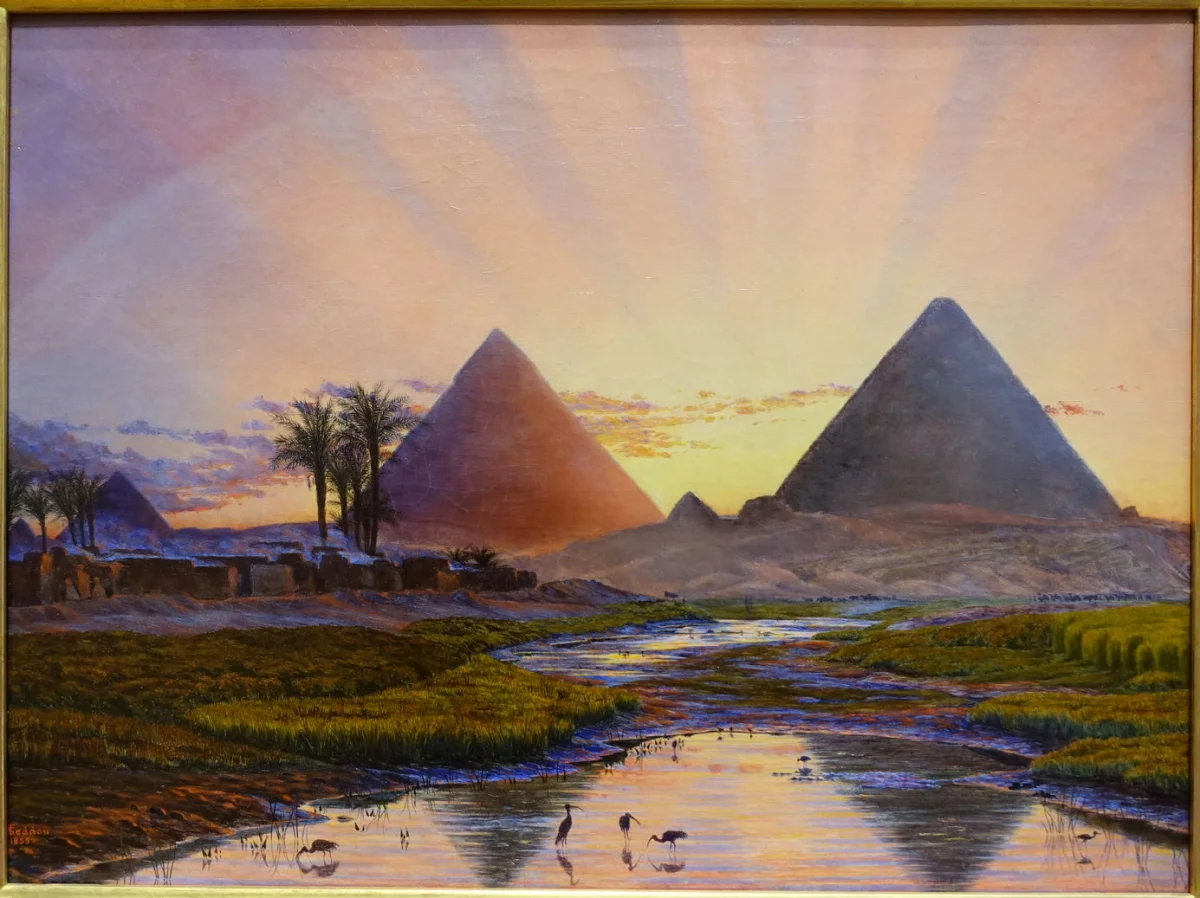
His final painting, The Pyramids at Gizeh, is believed to date from autumn 1856. A second version presents the same view in richer sunset colours. Seddon contracted dysentery soon afterward and died in Cairo on 23 November 1856, aged 35. His paintings were shown at a memorial exhibition the following year; critic John Ruskin praised his “perfect artistical skill” and “topographical accuracy.” That combination of careful rendering and personal interpretation remains central to how these works reward close looking.

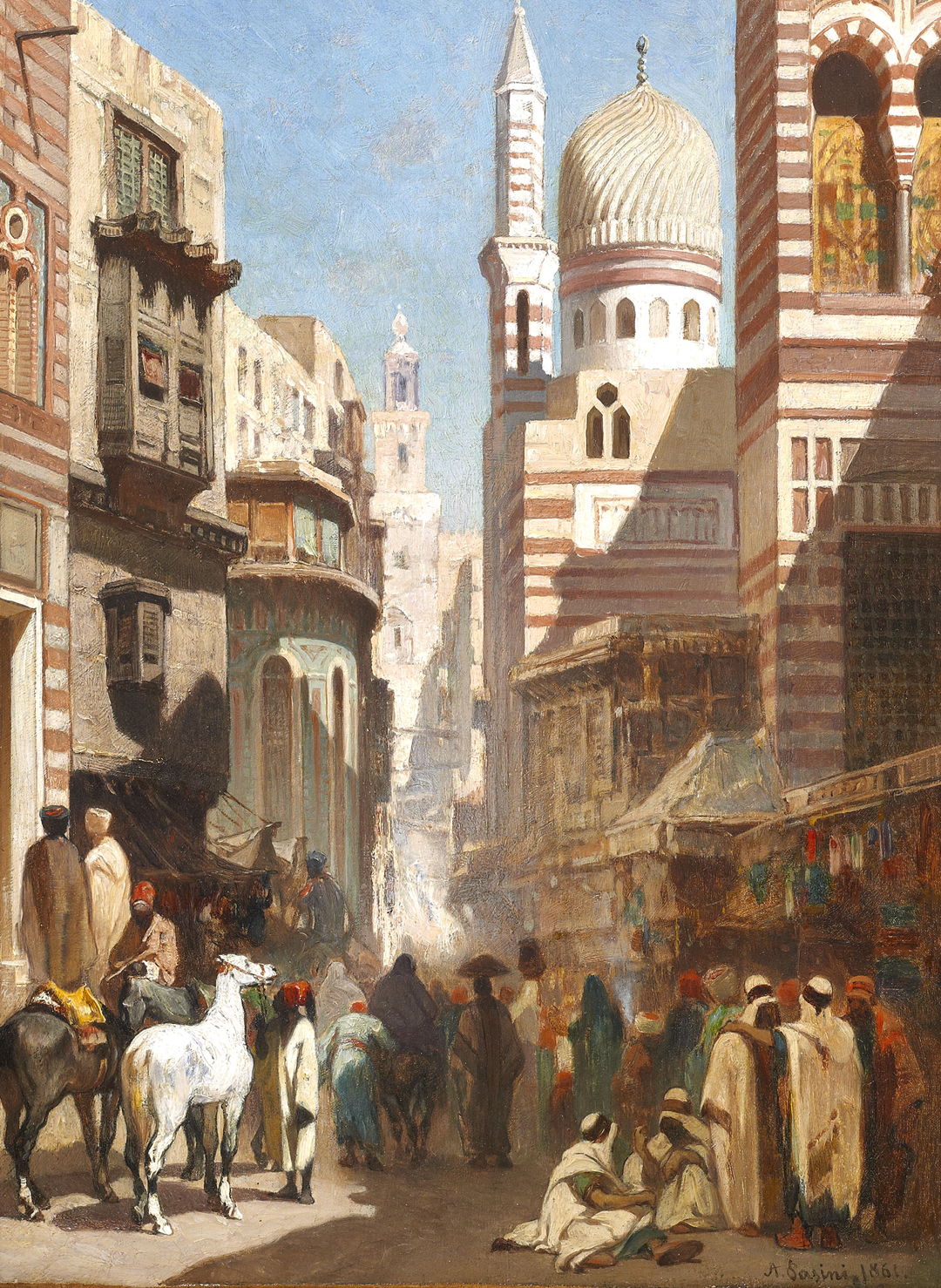
Alberto Pasini’s Al-Khudayri Street, Cairo (1861) brings the focus from ancient monuments to city life. The scene includes market stalls and people moving through the street, but Pasini keeps their faces out of view. Although the setting has been linked to the Ibn Tulun mosque, its spiral minaret and the Saladin fortress, the painting appears to combine architectural references rather than record one precise location. That blend of observation and reconstruction is a useful guide to the whole group: the paintings preserve what artists saw, studied and imagined about Egypt, often in the same frame.