European Artists in 19th-Century Egypt: From the Memnon Colossi to Cairo Streets
Paintings by Seitz, Gérôme, Bracht and others show how visiting artists recorded Egypt’s monuments, working life and city scenes.
By the late nineteenth century, European artists were travelling to Egypt in growing numbers, bringing back sketches and paintings of ancient monuments, city streets and everyday work. Their pictures vary widely: some turn the landscape into an atmospheric study of light, while others record people and places through the conventions of Orientalist painting. Together, they show how artists made Egypt a recurring subject—and how much their approaches differed.
The Memnon colossi as a study in light
The two statues associated with the myth of Memnon, at Al Bairat near Luxor, had been known since classical times. During the nineteenth century, they became popular subjects for visiting artists. The colossi offered a recognizable ancient landmark, but also a setting in which to explore distance, heat and light.

Gustav W. Seitz’s Egypt: the Statues of Memnon reaches viewers as a colour lithograph made from an original watercolour. Its atmospheric treatment makes the statues feel distant and monumental. The moon also appears to demonstrate the moon illusion: an object near the horizon can seem larger than the same object when higher in the sky. The effect links the painting’s mood to a familiar feature of human perception.

Charles Vacher’s 1864 watercolour, The Statues of the Memnons, makes colour the central attraction. Its broad format gives the scene room to unfold, and the rich palette sets it apart from Seitz’s more atmospheric interpretation. Both works use the same landmark, yet each makes a different case for what an image of it can do.

Albert Zimmermann’s oil painting brings another kind of observation to the subject. A heat haze softens the view, while a snake moves through the water. That small detail gives the scene a sense of movement that the monumental statues alone could not provide. It also shows how a familiar ancient site could become a setting for close attention to the surrounding environment.
From working fields to Cairo interiors
Jean-Léon Gérôme first visited Egypt in 1856 and went on to become a prolific painter of Orientalist subjects early in his career. His works range from scenes of labor to carefully staged interiors and performances. That range makes it useful to look at the paintings side by side: they document different subjects, while also reflecting an artist’s choices about which moments to present.

The Grain Threshers, Egypt (1859) depicts a traditional method of separating grain that was still widely used at the time. The subject shifts attention away from Egypt’s ancient remains and toward contemporary work. For a viewer interested in how people lived and labored, that shift matters: the painting’s subject is a practice, not a monument.

Four years later, Gérôme painted Dance of the Almeh (The Belly-Dancer), a more conventional Orientalist scene. To a modern viewer it may feel familiar to the point of cliché. Yet relatively few images of such places circulated among European audiences at the time, and some works showed locations that Europeans had scarcely visited. The historical value of that record sits alongside a need to consider how an artist’s framing shaped what audiences saw.

The Carpet Merchant (of Cairo), painted in 1887, uses its everyday surroundings to heighten the visual presence of the carpets. Their display lends them grandeur, while a white-robed figure in the deep shadow of a doorway just right of centre adds an unresolved note. Gérôme’s arrangement makes the scene feel observed and composed at once: the objects command attention, but the partly hidden figure leaves the viewer wondering what lies beyond the visible exchange.
Travel sketches, studio memories and distant views
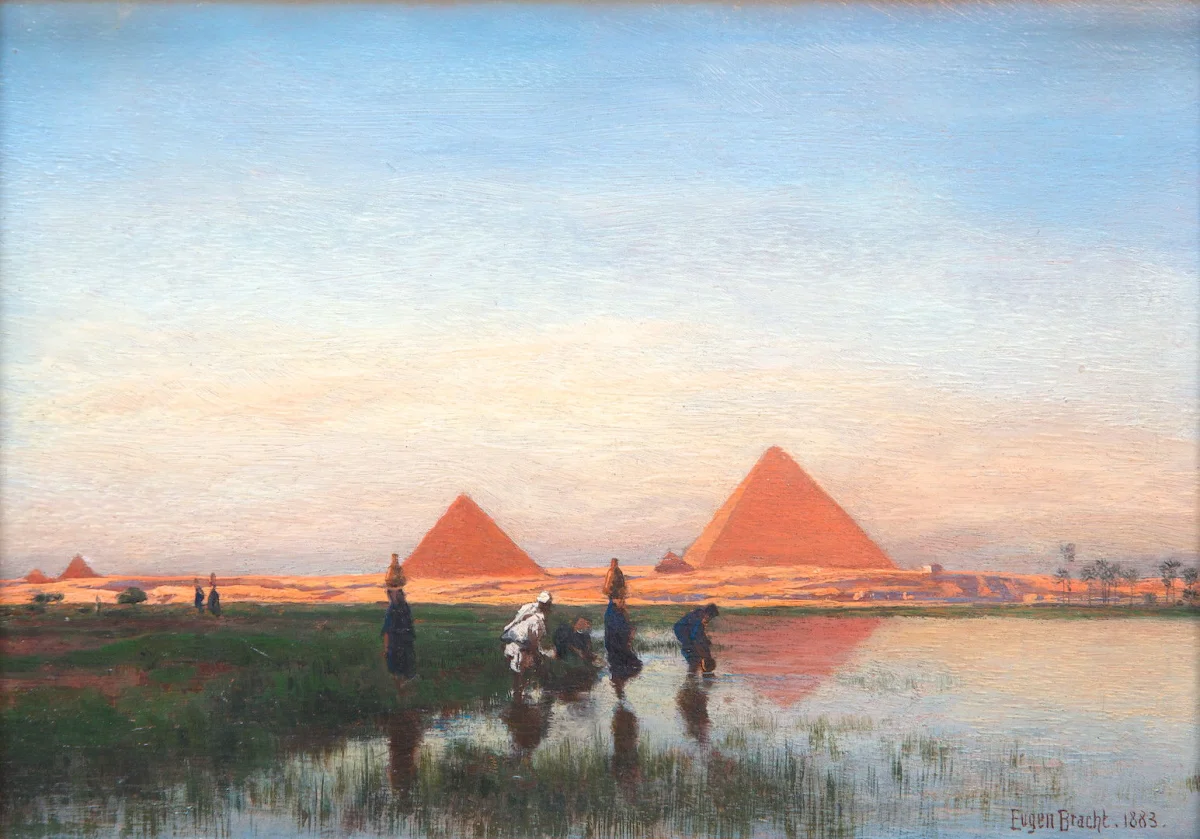
Eugen Bracht travelled through Egypt, Syria and Palestine in 1880–81, making sketches and studies that he later developed into finished oil paintings in his studio. That process separated the finished work from the place and moment of observation, giving memory a role alongside direct experience.

Painted after Bracht had returned to Berlin, Memory of Gizeh (1883) preserves the scene’s rich colours. Its title makes the act of recollection explicit. For artists working from travel studies, the studio offered room to refine a view, while also creating distance from the original encounter. The painting is therefore both an image of a place and a record of how that place stayed with its maker.

Hans Andersen Brendekilde was best known for Naturalist paintings of rural Denmark, but travelled across Europe, Egypt, Syria and Palestine in 1889–90. His The Graves of the Apostles Jacob and Zacharias near Cairo (1889–91) is an unusual view within this group. The graves appear in a cemetery on a hill above the city, with the Pyramids visible along the skyline. The composition brings a religious site, a city and Egypt’s most famous ancient structures into a single view.

Brendekilde’s Oriental Scene with the Pyramids of Giza in the Background, probably painted around 1890, sets a human scene against a landmark just outside Cairo. The Pyramids anchor the setting, but the painting’s subject extends beyond them. As with the cemetery view, the famous skyline acts as a point of reference for a wider picture of life and place.
Streeton’s brief view of Cairo
Arthur Streeton’s route to Europe began much farther away. The Australian Impressionist moved from Sydney to London in 1897, stopping in Cairo and Naples along the way. His brief visit produced a compact image of the city that depends on the intensity of a passing visual impression.

Cairo Street (Mosque, Sultan Hassan) (1897) is an oil sketch whose sunlight does much of the work. Its small format suits the immediacy of the view: rather than building a detailed account of the city, Streeton captures the dazzle of looking at it. Across these paintings, the useful comparison is not simply between ancient and modern subjects. It is between different ways of seeing Egypt—through colour, atmosphere, labor, staged scenes, remembered studies and fleeting light. That variety is what keeps the images worth looking at together.