Painting with impaired vision: Camille Pissarro
How chronic problems with the tear duct of his right eye drove Pissarro from painting landscapes outdoors to painting cityscapes from hotel rooms.
Another of the French Impressionists to have suffered and coped with chronic eye disease is Camille Pissarro. From the outset of his career he specialised in landscape painting in front of the motif, and was taught by Camille Corot, at the time the greatest exponent of painting en plein air.
Although both teacher and pupil took advantage of warmer conditions when they could, Pissarro soon established a reputation for painting outdoors all year round, even in the bitter winters of northern France.

Prior to the Franco-Prussian War Pissarro’s winter paintings concentrated on road scenes, with attendant trees, centred on Louveciennes, a theme he continued for many years.

This is a wintry scene of The Post-House, the Route de Versailles, Louveciennes, Effect of Snow from 1872. This looks from the ‘Royal Gate’ of the Château de Marly towards the post-house, a landmark featured in several of Pissarro’s works from this period. This painting was bought that Spring by Durand-Ruel, who sold it a year later to Jean-Baptiste Faure, the opera singer and Pissarro’s first collector.
At the end of 1880, when he was in Paris, Pissarro started to report the first symptoms of the eye problems which were to limit his painting later in his life. By 1889, these were serious enough to take him to a specialist in Paris, who found the duct draining the artist’s tears from his right eye was blocked because of recurrent infection of the tear sac on that side. Pissarro was told to avoid wind and dust, and to wash the eye immediately should anything get into it. Later he was required to wear a bandage over his right eye for at least a month.
In July 1891, Pissarro’s abscess was drained, and he was allowed to work, but indoors only with the windows closed. From May to August 1892 the artist was in London to sort out his son Lucien’s wedding which took place that summer. After a brief stay in the city, he moved out to Kew (in the south-western suburbs, and home to the famous botanical garden), where he painted a total of eleven canvases.

Pissarro painted Bank Holiday, Kew (1892) from the balcony of his rented flat in Kew, on the summer public holiday in early August. This is the precursor to his later densely populated urban landscapes.
In early 1893, Pissarro had to stay in Paris again for treatment of an abscess on one eye. His doctor gave him strict instructions to avoid exposing that eye to dust in the street, so the artist took a room at the Hôtel-Restaurant de Rome, giving him good views of the busy junction below. From there, he started to paint the cityscapes that came to dominate this late phase in his painting.

Place du Havre and Rue Amsterdam, Morning, Sunlight (1893) is one of Pissarro’s first populous cityscapes. He had completed this painting by March, when he sold it to Durand-Ruel.

He still managed to paint some views of the snowy conditions at Éragny in early 1895 including Poplar Trees, Effect of Sunlight, Winter, Éragny. This features a poorly-dressed country woman carrying a couple of pails in the snow.
In January 1896, Pissarro returned to the city of Rouen for a second period painting there, with the aim of completing eight to ten views of the city, with which he was already familiar. As it turned out, painting in the Hôtel de Paris that winter was little better for his eyes than being outdoors: his accommodation proved bitterly cold and drafty, but at least he was able to remain behind glass. When he returned to Éragny at the end of March, he had fifteen canvases with which to establish an urban theme for the late years of his career.

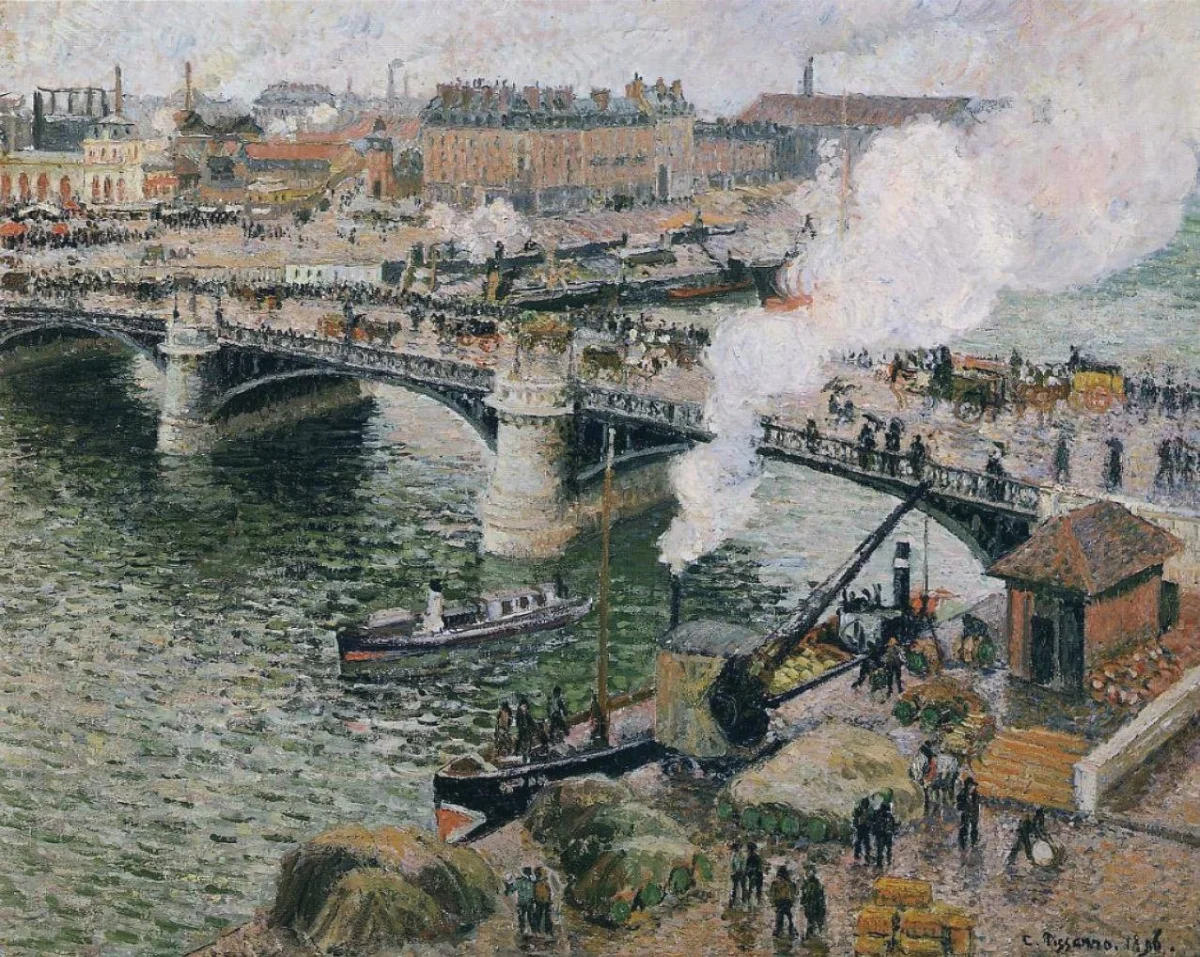
Pont Boieldieu in Rouen, Rainy Weather (1896) is one of the finest examples of the view from Pissarro’s icy hotel room, looking out over the intense activity on and around this iron bridge which had only been completed in 1888. The artist became fascinated with the appearance of this bridge in different weather conditions, and the critics agreed both with his choice of motif and his impressions of it. When Pissarro returned to Rouen in the autumn of that year, and again in 1898, it remained one of his favourite motifs there.
In 1897, Pissarro transferred his attentions back to Paris. In January, he painted from a hotel room overlooking the Rue Saint-Lazare, then in February transferred to a room with a view over the Boulevard Montmartre, where he painted some of his most famous cityscapes.

Boulevard Montmartre, Spring Morning (1897) is composed primarily of buildings and streets, a plethora of figures, and countless carriages to move those people around, the ingredients for so many of his late paintings.
These series were broken suddenly when Pissarro had to rush to his son Lucien in London, who fell seriously ill in May 1897. It was to be Pissarro’s last visit overseas: when his third son Félix died of tuberculosis in London in November of that year, the artist’s eye condition was too bad for him to travel. At the end of that dreadful year in his family life, Durand-Ruel encouraged Pissarro to return to Paris. So he did, staying from the end of the year until April 1898, painting views of the Place du Théâtre-Français and its environs.

In his Rue Saint-Honoré, Sun Effect, Afternoon (1898), the human throng is more scattered, and the carriages and figures in the foreground rather larger.
From July to October 1898, Pissarro returned to Rouen, where he completed twenty canvases during his last working visit to the city.

A new motif, given the more favourable weather during the late summer, is Rue de l’Épicerie, Rouen, Effect of Sunlight, one of a series of just three paintings showing one of the oldest streets in the city as it runs between sixteenth century houses near the cathedral.
At the end of 1898, Pissarro rented a flat for his family in Paris, from where he enjoyed a superb view over the Tuileries Gardens, which, unlike Monet and Renoir, he hadn’t painted until late in his career. His first series of eleven paintings was sold to Durand-Ruel in May for the sum of 27,000 Francs. The artist then returned to the same flat to paint a second series at the end of 1899.
Pissarro’s eye problems were demanding more medical attention, but as he entered the twentieth century, there seemed no holding back his painting. His series of cityscapes made from behind the windows of hotel rooms and apartments were proving highly successful: at the end of March 1900, Durand-Ruel bought nine that he had painted when the Pissarro family had stayed in an apartment on the Rue de Rivoli in Paris.
Pissarro travelled frequently over these years too, to continue painting series of cityscapes, and at times like the autumn/fall to return to Éragny for its rich colours. In early June 1901, Pissarro left Éragny to explore the Channel coast in search of a suitable location to paint during that summer. He settled on Dieppe, which was within easy reach of Paris and his eye care there. He stayed in the port from late July to the end of September, during which he made nine oil paintings from the window of his hotel.

His visit did, though, coincide with a summer fair, which he painted in The Town Fair by the Church of Saint-Jacques in Dieppe, Morning, Sunlight (1901). This is a late example of Pissarro’s enduring affection for markets and fairs, as well as an exceptionally dense human landscape.

Among the series which he completed in the city of Paris is this amazing view of the crowds on the Pont-Neuf bridge in Paris, in 1902.
From early July to the end of September 1902, Pissarro paid a return visit to the port of Dieppe, where he turned his attention to its harbour, a theme developed from his earlier series showing docks in Rouen.

The Outer Harbour at Dieppe, Morning, Overcast Sky (1902) shows a small steam packet which is unlikely, even in summer, to have crossed the Channel, but may have taken tourists on day cruises along this stretch of coast.
During the period 1893 to 1903, Pissarro painted ten series of urban landscapes, including:
- Gare Saint-Lazaire, Paris, a total of 5 from 1893 and 1897;
- Rouen, a branched series of 45 paintings from 1896 and 1898;
- Boulevard Montmartre, Paris, a tight series of 14 paintings from 1897;
- Avenue de l’Opera, Paris, a branched series of 15 paintings from 1897;
- Tuileries Gardens, Paris, a branched series of 31 paintings from 1899-1900;
- Coin du jardin à Éragny, a series of 5 paintings from 1899;
- Louvre, Pont Neuf, Pont Royal, Quai Malaquais, Paris, a branched series of 71 paintings from 1900 to 1903;
- Church of Saint-Jacques, Dieppe, a series of 6 paintings from 1901;
- The Harbours, Dieppe, a branched series of 16 paintings from 1902;
- Le Havre, a branched series of 23 paintings completed shortly before his final illness in 1903.
Only one of those, at Éragny, was painted outdoors.
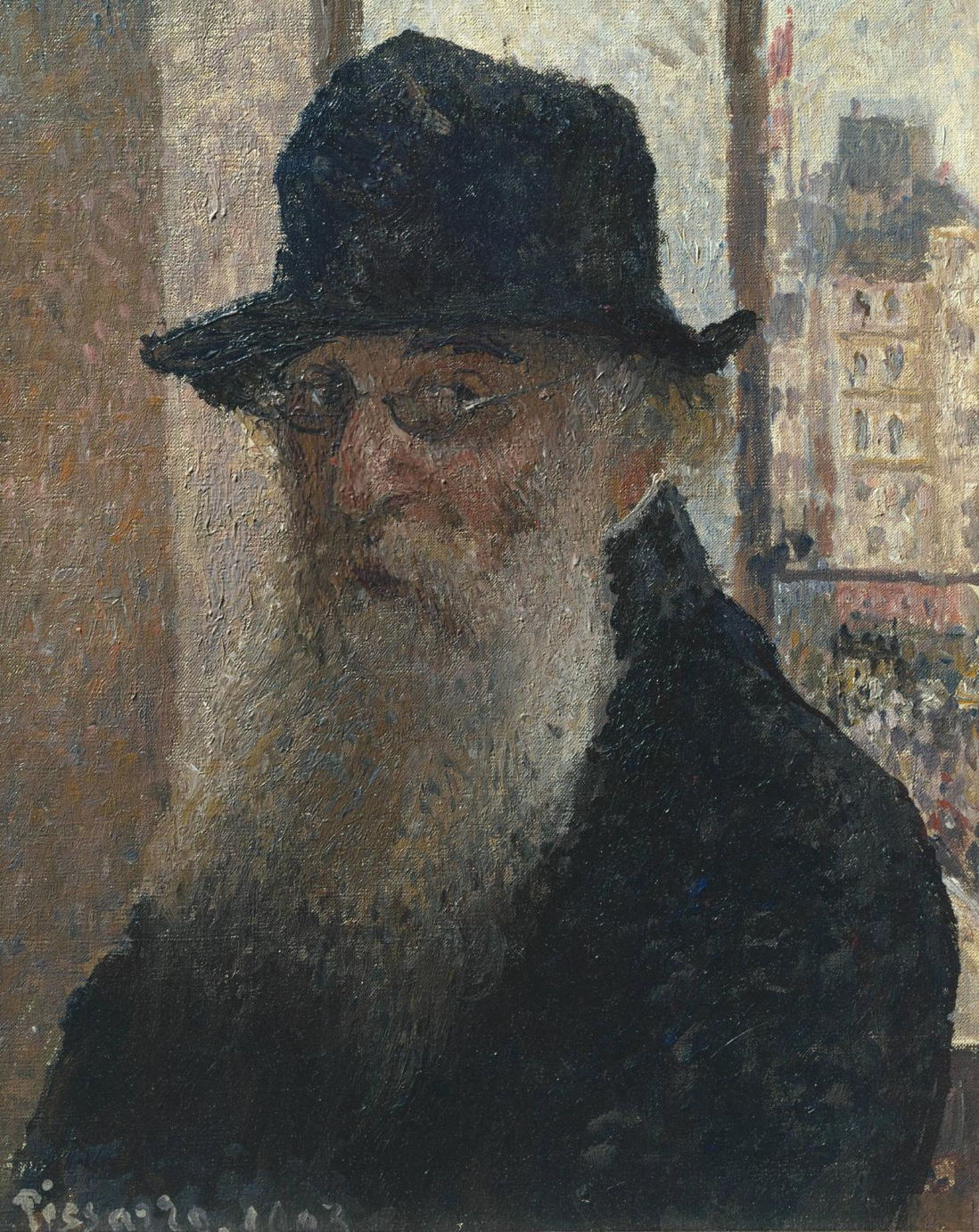
At the end of September, Pissarro returned to Paris from his summer travels. Shortly before moving to a new flat, at the age of seventy-three, he painted this last Self-Portrait with Hat (1903). In early October he fell ill, and on 13 November 1903 died in Paris.
Although there were times when his eye condition did restrict his painting, its main effect was to force him to change his motifs from country landscapes to the innovative cityscapes he pioneered so successfully in the last decade of his career.
References
Brettell RR (1990) Pissarro and Pontoise, Yale UP and Guild. ISBN 978 0 300 04336 5.
Pissarro J (1993) Pissarro, Pavilion Books and Harry N Abrams. ISBN 1 85793 124 6.
Pissarro J and Snollaerts CD-R (2005) Pissarro. Critical Catalogue of Paintings, 3 vols, Wildenstein Institute and Skira. ISBN 88 7624 525 1.
Rothkopf K ed (2006) Pissarro. Creating the Impressionist Landscape, Philip Wilson, London. ISBN 0 85667 630 6.
Michael F Marmor & James G Ravin (2009) The Artist’s Eyes. Vision and the History of Art, Abrams. ISBN 978 0 8109 4849 5.